
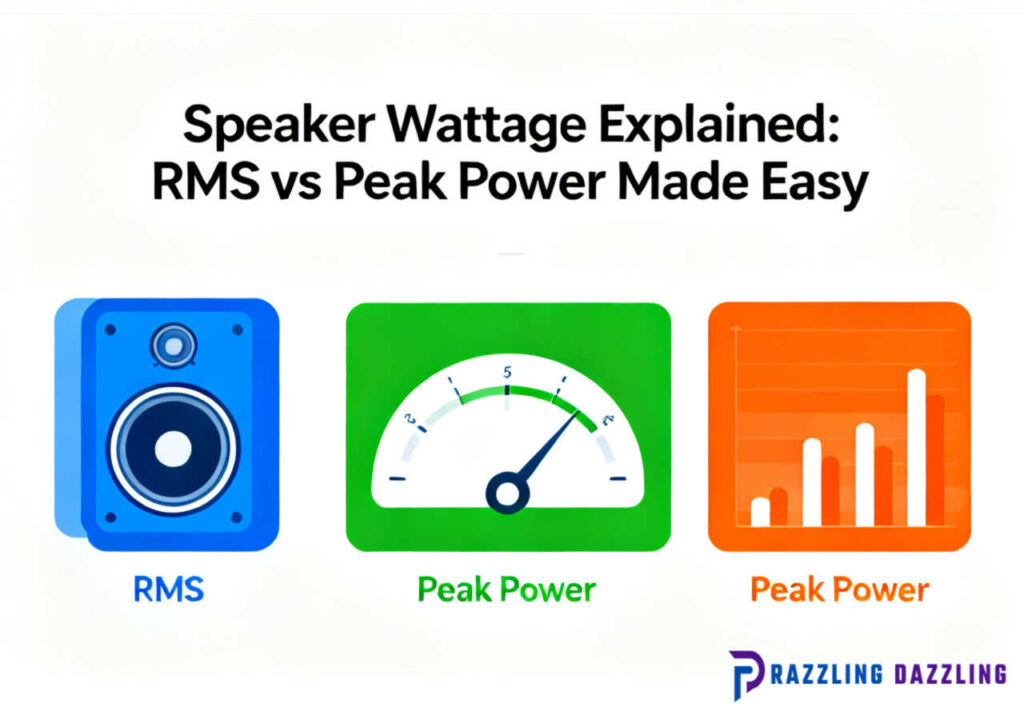
Understanding speaker wattage can feel confusing, especially when you see terms like RMS, peak power, and maximum wattage on product labels. Many people assume higher wattage always means louder or better sound but that’s not entirely true. To make smarter audio decisions, it’s important to understand what these terms actually mean and how they affect real world performance.
In this complete guide by Razzling Dazzling, we’ll break down speaker wattage in simple terms, compare RMS vs peak power, and help you choose the right speakers for your needs.
What Is Speaker Wattage?
Speaker wattage refers to how much electrical power a speaker can handle and convert into sound. It’s measured in watts (W) and plays a key role in determining how loud and clear a speaker can perform without distortion or damage.
However, wattage alone doesn’t define sound quality. Factors like speaker sensitivity, design, and environment also play a big role. Wattage is just one piece of the puzzle.
Understanding RMS Power
RMS stands for Root Mean Square, and it represents the continuous power a speaker can handle over time without overheating or distorting.
Key Features of RMS Power:
- Indicates consistent, real world performance
- More reliable than peak power ratings
- Helps determine safe amplifier matching
- Ideal for long listening sessions
Think of RMS as your speaker’s steady working capacity. If a speaker has an RMS rating of 50W, it means it can comfortably handle 50 watts of continuous power.
Why RMS Matters
RMS is the most important specification when choosing speakers because it reflects how the speaker will perform in everyday use. It ensures:
- Stable sound output
- Minimal distortion
- Longer speaker lifespan
What Is Peak Power?
Peak power (also called maximum power) refers to the highest level of power a speaker can handle for a very short period without getting damaged.
Key Features of Peak Power:
- Represents short bursts of energy
- Not suitable for continuous use
- Often used in marketing to show higher numbers
For example, a speaker labeled as 200W peak may only have an RMS rating of 50W. That means it can briefly handle 200 watts, but running it at that level continuously would damage it.
Why Peak Power Can Be Misleading
Peak power numbers often look impressive, but they don’t reflect real performance. Relying only on peak ratings can lead to:
- Poor sound quality
- Overpowered systems
- Risk of speaker damage
RMS vs Peak Power: The Key Differences
| Feature | RMS Power | Peak Power |
| Definition | Continuous power handling | Maximum short term power |
| Reliability | Highly reliable | Less reliable |
| Usage | Everyday listening | Brief sound bursts |
| Importance | Most important spec | Secondary spec |
| Risk Level | Safe | Risky if misused |
Simple Analogy: Think of RMS like your daily walking speed, while peak power is like sprinting. You can sprint for a few seconds, but you can’t maintain that speed for long.
Does Higher Wattage Mean Louder Sound?
Not necessarily.
Many people believe that doubling wattage doubles loudness but in reality, sound perception works differently.
The Truth About Loudness:
- Doubling wattage increases volume by only about 3 decibels (dB)
- To noticeably double loudness, you need about 10 times more power
Example:
- 50W speaker → moderate volume
- 100W speaker → slightly louder
- 500W speaker → significantly louder
So, wattage alone doesn’t determine loudness; speaker sensitivity plays a big role too.
Speaker Sensitivity: The Hidden Factor
Speaker sensitivity measures how efficiently a speaker converts power into sound. It’s usually expressed in dB (decibels).
Why It Matters:
- A high sensitivity speaker needs less power to produce loud sound
- A low sensitivity speaker needs more power
Example:
- Speaker A: 90 dB sensitivity
- Speaker B: 100 dB sensitivity
Speaker B will sound much louder than Speaker A even at the same wattage.
Matching Speakers with Amplifiers
To get the best performance, you need to match your speaker’s RMS rating with your amplifier’s output.
Basic Rule:
- Amplifier power should be equal to or slightly higher than speaker RMS
Example:
- Speaker RMS: 100W
- Ideal amplifier: 80W–120W
Why This Matters:
- Too little power → distortion (clipping)
- Too much power → risk of damage
A balanced setup ensures clean sound and protects your equipment.
Real World Applications
Home Audio Systems
For casual listening:
- RMS: 20W–100W per speaker
- Focus on clarity over power
Car Audio Systems
For louder environments:
- RMS: 50W–150W per speaker
- Match with proper amplifier
Professional Sound Systems
For events or concerts:
- RMS: 200W–1000W+
- Requires high quality components
How to Choose the Right Speaker Wattage
Define Your Use Case:
- Small room → lower wattage
- Large space → higher wattage
Check RMS Rating: Always prioritize RMS over peak power.
Consider Sensitivity: Higher sensitivity = louder sound with less power.
Match with Amplifier: Ensure compatibility for best performance.
Tips for Getting the Best Sound
- Avoid pushing speakers to maximum limits
- Use a quality amplifier
- Place speakers correctly in the room
- Consider acoustics (walls, furniture, etc.)
Why Manufacturers Use Peak Power
Peak power ratings are often used for marketing purposes because they make products look more powerful.
However, smart buyers should:
- Focus on RMS ratings
- Ignore exaggerated peak numbers
- Look for honest specifications
Understanding Power Handling vs Power Output
Power Handling (Speakers)
- How much power a speaker can safely handle
Power Output (Amplifiers)
- How much power an amplifier delivers
Both must be balanced to avoid distortion or damage.
The Role of Impedance
Impedance (measured in ohms) also affects power delivery.
Common Ratings:
- 4 ohms → more power, less resistance
- 8 ohms → standard home audio
Make sure your amplifier supports your speaker’s impedance.
Practical Example
Let’s say you have:
- Speaker: 60W RMS, 120W peak
- Amplifier: 70W output
This is a good match because:
- RMS levels are close
- Slight extra power ensures clean sound
- Low risk of distortion
Common Questions About Speaker Wattage
Is RMS more important than peak power?
Yes, RMS is far more important because it reflects real world performance and continuous power handling.
Can I use a higher watt amplifier than my speaker?
Yes, but only slightly higher than the speaker’s RMS rating to avoid damage.
Does higher wattage mean louder speakers?
Not always. Loudness also depends on speaker sensitivity and efficiency.
What happens if I overpower my speakers?
Overpowering can cause distortion, overheating, and permanent damage.
What is a good RMS wattage for home use?
For most home setups, 20W to 100W RMS per speaker is sufficient.
Understanding speaker wattage doesn’t have to be complicated. The key takeaway is simple:
- RMS power matters most
- Peak power is just a temporary limit
- Wattage alone doesn’t define loudness or quality
By focusing on RMS ratings, speaker sensitivity, and proper matching with amplifiers, you can build an audio system that delivers clear, powerful, and distortion free sound.At Razzling Dazzling, we believe that informed choices lead to better experiences. Whether you’re setting up a home theater, upgrading your car audio, or building a professional sound system, knowing the difference between RMS and peak power will help you make smarter decisions.