
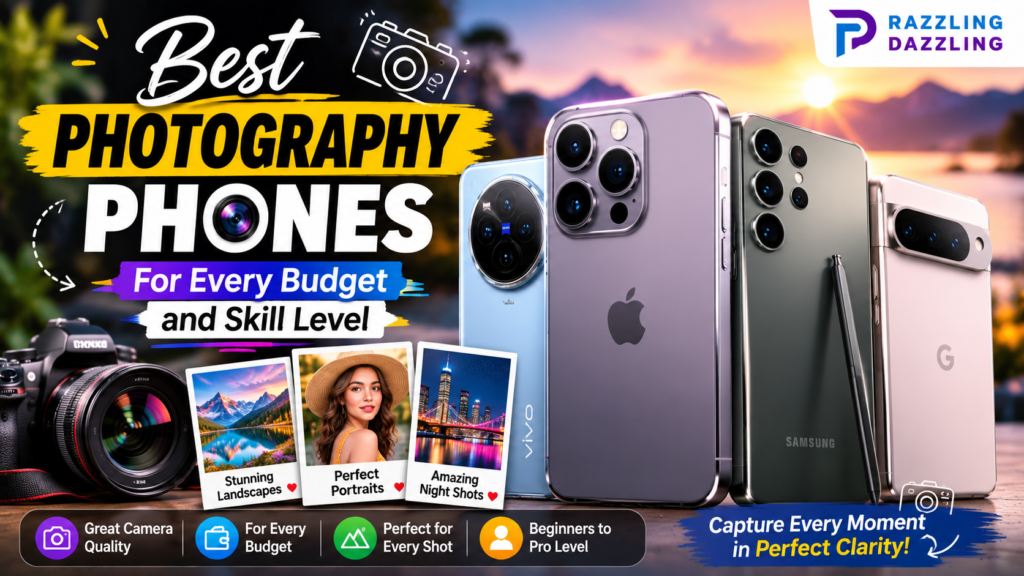
You no longer need a dedicated camera to take impressive photos. Modern smartphones combine capable camera hardware with sophisticated image processing, stabilization, portrait modes, night photography, and increasingly powerful editing tools. As a result, choosing the right photography phone is less about finding the phone with the biggest megapixel number and more about matching the camera system to your photography style and budget.
In 2026, camera phones are available across almost every price category. Affordable models can produce excellent daylight images, mid-range phones increasingly offer stronger stabilization and multiple useful lenses, while flagship devices deliver sophisticated zoom, low-light performance, video capabilities, and manual controls.
At Razzling Dazzling, we believe choosing technology should be simple and practical. This guide breaks down the most important photography features and explains what different types of photographers should look for before buying a new phone.
What Makes a Phone Good for Photography?
Before looking at individual phones, it helps to understand which specifications actually matter.
Camera Sensor
The sensor is one of the most important parts of a smartphone camera. A larger sensor can capture more light, which can help improve detail and image quality, particularly in challenging lighting conditions.
This is one reason a phone with a lower megapixel count can sometimes produce better photographs than a phone advertising a much higher resolution.
Optical Image Stabilization
Optical Image Stabilization, or OIS, helps reduce the effect of small hand movements when taking photographs and recording video. It can be particularly useful for low-light photography because slower shutter speeds are more vulnerable to camera shake.
OIS is now available on many mid-range smartphones, making it an increasingly important feature to look for when shopping on a budget.
Image Processing
Smartphone photography relies heavily on software. HDR processing, noise reduction, exposure management, portrait separation, skin-tone processing, and night photography can dramatically affect the final image.
This is why two phones with similar camera specifications can produce noticeably different results.
Multiple Lenses
A versatile camera system can include a main camera, ultrawide camera, and telephoto camera. Each serves a different purpose.
The main camera is generally the everyday option, ultrawide is useful for landscapes and groups, and telephoto helps with distant subjects and portraits.
Video Features
If you also create videos, look for features such as 4K recording, stabilization, reliable autofocus, good microphones, and consistent color between lenses.
Some premium smartphones now offer particularly advanced video tools, making them attractive to creators who use a phone as their primary camera.
Best Budget Photography Phones
You don’t necessarily have to spend flagship-level money to get a capable smartphone camera. Current budget recommendations include models such as the Google Pixel 10a, CMF Phone 2 Pro, and Samsung Galaxy A-series phones.
Google Pixel 10a – Excellent Choice for Easy Photography
The Pixel 10a is particularly appealing to photographers who want good results without spending a premium price. Its biggest advantage is Google’s computational photography approach, which can help produce attractive images without requiring extensive manual adjustments.
It can be a strong choice for beginners because you can point, shoot, and allow the phone’s processing to handle much of the work.
Best for: Beginners, everyday photography, travel, and social media photos.
Samsung Galaxy A-Series – Strong Everyday Value
Samsung’s mid-range A-series provides another practical option for shoppers who want a balanced phone with a capable camera. Models such as the Galaxy A36 5G offer a 50MP main camera with OIS and an ultrawide camera, providing useful flexibility at a more accessible price.
For beginners, having OIS and an ultrawide camera can be more useful than simply choosing a phone based on its highest megapixel specification.
Best for: Students, families, casual photographers, and everyday users.
CMF Phone 2 Pro – Budget-Friendly Creative Option
The CMF Phone 2 Pro is another budget-oriented option highlighted by current camera-phone guides. It combines a high-resolution main camera with a distinctive design and additional camera functionality.
Its appeal is particularly strong for people who want something different from the mainstream smartphone designs.
Best for: Budget-conscious users who want creative flexibility.
Best Mid-Range Photography Phones
The mid-range category is becoming increasingly interesting for mobile photographers. You can find phones with OIS, strong image processing, ultrawide cameras, higher-quality displays, and sometimes dedicated telephoto lenses without moving all the way into flagship pricing.
Samsung Galaxy S25 FE – Versatile Photography Choice
The Galaxy S25 FE is one example of a phone that bridges the gap between mainstream and premium photography. Current Bangladesh-focused photography guides highlight its combination of a 50MP main camera with OIS, an ultrawide camera, and a telephoto lens with 3x optical zoom.
That combination makes it useful for photographers who don’t want to carry a separate camera but still want multiple focal lengths.
Best for: Enthusiasts who want versatility.
OPPO Reno Series – Strong Portrait and Everyday Photography
Recent smartphone testing has highlighted the strengths of OPPO’s higher-end Reno models, particularly their combination of main, ultrawide, and telephoto cameras. The OPPO Reno14 Pro, for example, has been noted for detailed main-camera images, a useful ultrawide, and a telephoto camera suited to portraits.
Best for: Portrait photography and everyday creative shooting.
OnePlus Nord CE5 – Good Value for Casual Creators
The OnePlus Nord CE5 offers a 50MP main camera and an ultrawide camera alongside strong overall hardware and battery performance. Its camera system is not intended to compete directly with premium flagship systems, but it can make sense for users who want a capable everyday phone without prioritizing photography above everything else.
Best for: Casual photography and users who value battery life as well as camera performance.
Best Premium Photography Phones
If photography is one of the main reasons you’re upgrading your phone, premium devices provide considerably more flexibility.
Samsung Galaxy S26 Ultra – Best for Versatility and Zoom
The Galaxy S26 Ultra stands out for photographers who want a broad range of shooting options. Current testing highlights its strong zoom performance, dependable overall camera results, and useful video features.
Its appeal is not based on one camera alone. Instead, the system is designed to cover different shooting situations, from everyday photographs to distant subjects and video.
Best for: Travel, wildlife-style distant subjects, portraits, and versatile mobile photography.
iPhone 17 Pro Max – Excellent for Photography and Video
The iPhone 17 Pro Max is another premium option for people who want both photography and video capabilities. Current testing places it among the leading camera phones, with particularly strong image quality and advanced video capabilities.
For creators who frequently switch between still photography and video, this combination can be especially useful.
Best for: Creators, video shooters, and photographers who want a polished all-around experience.
Google Pixel Pro Series – Excellent Computational Photography
Google’s premium Pixel phones are especially interesting for photographers who prefer computational photography and software-assisted tools.
The Pixel 10 Pro XL has been recognized for AI-assisted photography features, including tools designed to help users improve how they capture images.
Best for: Beginners moving into enthusiast photography and people who enjoy software-based editing tools.
Best Photography Phones for Beginners
If you’re new to photography, don’t automatically choose the phone with the most advanced specifications.
A beginner-friendly camera should make it easy to get good results without requiring extensive manual knowledge.
Look for:
- Reliable automatic exposure
- Good HDR processing
- OIS
- A useful main camera
- An effective portrait mode
- Good low-light processing
- Simple editing tools
- Consistent autofocus
Computational photography can be particularly helpful here because the phone automatically handles many technical decisions.
A phone that consistently produces attractive photographs with minimal effort may be more useful to a beginner than a device packed with professional controls.
Best Photography Phones for Enthusiasts
Enthusiast photographers usually want more control.
If you already understand concepts such as exposure, focal length, shutter speed, ISO, and composition, look for a phone offering manual controls, RAW capture, multiple focal lengths, and strong stabilization.
Samsung, Apple, Google, and several Chinese smartphone manufacturers offer increasingly sophisticated camera software and hardware at the premium end of the market.
Some devices also provide specialized photography modes that let users experiment beyond ordinary point-and-shoot photography.
Best Phones for Portrait Photography
Portrait photography depends on more than megapixels. Lens selection, subject separation, skin-tone processing, autofocus, and image processing all influence the final result.
A dedicated telephoto camera can be particularly useful because it lets photographers frame subjects without moving extremely close.
When choosing a portrait-focused phone, consider:
- Telephoto capability
- Autofocus performance
- Natural background separation
- Skin-tone rendering
- Low-light portrait performance
A phone that handles these areas consistently can be more valuable than one that simply advertises a very high-resolution main camera.
Best Phones for Low-Light Photography
Low-light photography is one of the biggest areas where premium phones can separate themselves from cheaper models.
A larger sensor, wider aperture, OIS, and strong computational photography can all contribute to better nighttime images.
OIS is particularly useful because it helps keep the camera steady during longer exposures. Larger sensors can also gather more light, while computational photography can combine multiple exposures and process noise.
When comparing phones for night photography, don’t focus only on the megapixel count. Look at real-world image quality, stabilization, dynamic range, and how naturally the phone processes shadows and highlights.
Best Phones for Travel Photography
A smartphone can be an excellent travel camera because it’s compact and always available.
For travel photography, versatility is often more valuable than having the absolute highest-resolution sensor. An ultrawide camera can capture architecture and landscapes, while a telephoto lens can help photograph distant details.
Battery life is also important. A camera phone is much less useful during a full day of sightseeing if its battery cannot keep up.
For travelers, prioritize:
- Main camera quality
- Ultrawide camera
- Telephoto or optical zoom
- Battery life
- Fast charging
- Storage capacity
- Water and dust resistance
- Reliable video stabilization
Don’t Choose a Phone Based Only on Megapixels
One of the biggest mistakes shoppers make is assuming more megapixels automatically means better photographs.
A high-resolution sensor can provide additional detail and cropping flexibility, but other factors can be equally or more important. Sensor size, lens quality, stabilization, autofocus, processing, and software all influence the final photograph.
Current camera-phone guides emphasize looking beyond resolution and considering the complete imaging system.
Think of megapixels as one part of the camera specification rather than the entire story.
How Much Should You Spend on a Photography Phone?
Your ideal budget depends on your photography goals.
Entry-Level Budget
If you mainly photograph family moments, food, pets, travel snapshots, and social media content, an affordable camera phone may be enough.
Mid-Range Budget
This category is ideal for enthusiasts who want better stabilization, stronger processing, and greater camera versatility without paying flagship prices.
Premium Budget
Premium phones make the most sense if photography and video are major priorities. They tend to offer better lens selection, advanced zoom, stronger low-light performance, professional controls, and more sophisticated video capabilities.
The goal isn’t to spend as much as possible. It’s to spend enough to get the features you’ll actually use.
Simple Tips for Taking Better Smartphone Photos
Even the best photography phone cannot replace good technique.
Clean Your Lens
A smudged lens can make photographs appear soft or hazy. Give the camera lenses a quick clean before important shots.
Use Natural Light
Whenever possible, use soft natural light. It can create more flattering and detailed photographs than harsh direct lighting.
Avoid Excessive Digital Zoom
Digital zoom can reduce image quality. If your phone has an optical telephoto camera, use it when appropriate.
Try Different Angles
Move around rather than taking every photograph from standing height. A small change in perspective can dramatically improve composition.
Don’t Overuse Filters
Editing can improve a photograph, but excessive filters can make images look unnatural. Start with small adjustments to exposure, contrast, highlights, shadows, and color.
How to Choose the Right Photography Phone
Before buying, ask yourself five questions:
What do I photograph most?
Portraits, landscapes, food, travel, pets, products, or video?
How much can I comfortably spend?
Set a realistic budget before comparing specifications.
Do I need optical zoom?
If you frequently photograph distant subjects, a telephoto lens can be extremely useful.
Do I shoot video?
If yes, pay attention to stabilization, resolution, frame rates, microphones, and autofocus.
Do I want automatic or manual photography?
Beginners may prefer excellent automatic processing, while enthusiasts may want RAW and manual controls.
The best photography phone isn’t necessarily the most expensive smartphone on the market. The right choice depends on your budget, experience, photography style, and the features you actually need.
Budget phones can now produce impressive everyday photographs, while mid-range devices provide increasingly sophisticated camera systems. Premium models take things further with advanced zoom, larger sensors, powerful processing, professional controls, and high-end video capabilities.
For beginners, prioritize simplicity and consistent results. Enthusiasts should look for greater control and lens versatility. Advanced photographers and creators may benefit from premium hardware, RAW capture, telephoto cameras, and advanced video tools.
At Razzling Dazzling, our goal is to make technology choices easier to understand. Explore our guides and reviews for more practical advice on smartphones, home technology, gadgets, and lifestyle products.
Frequently Asked Questions
1. What is the best photography phone for beginners?
A phone with strong automatic image processing, reliable autofocus, OIS, and simple editing tools is generally a good choice for beginners. The Google Pixel series is particularly appealing to users who want strong results without extensive manual controls.
2. Are expensive phones always better for photography?
Not necessarily. Premium phones generally provide more camera versatility and advanced features, but affordable and mid-range phones can produce excellent photographs, particularly in good lighting.
3. Is a 200MP camera better than a 50MP camera?
Not automatically. Megapixel count is only one factor. Sensor size, lens quality, OIS, autofocus, image processing, and software can have a major impact on photograph quality.
4. What is OIS and why is it important?
OIS stands for Optical Image Stabilization. It helps compensate for small movements of the phone while taking photos or recording video and can be particularly useful in low-light situations.
5. Which camera phone is best for travel photography?
A good travel phone should have a strong main camera, an ultrawide lens, useful zoom, good battery life, and reliable video stabilization. Versatility is often more important than maximum megapixel resolution.
6. Do I need a telephoto camera for photography?
You don’t need one for everyday photography, but telephoto cameras are useful for portraits, distant subjects, travel details, and situations where you cannot physically move closer to your subject.
7. Is a phone good enough for professional photography?
Modern flagship smartphones can produce high-quality photographs and video for many professional applications. However, dedicated cameras can still provide advantages such as larger sensors, interchangeable lenses, and greater creative control.
8. What should I look for in a budget photography phone?
Prioritize a good main sensor, OIS, reliable image processing, autofocus, useful battery life, and—if available—an ultrawide camera. Don’t choose solely by megapixel count.
Ready to Find Your Next Photography Phone?
Don’t choose your next smartphone based on a single camera specification. Think about the way you actually take photographs, compare the features that matter most to you, and choose a phone that fits both your skill level and budget. Keep exploring Razzling Dazzling for straightforward buying guides and practical technology advice designed to help you shop smarter.