
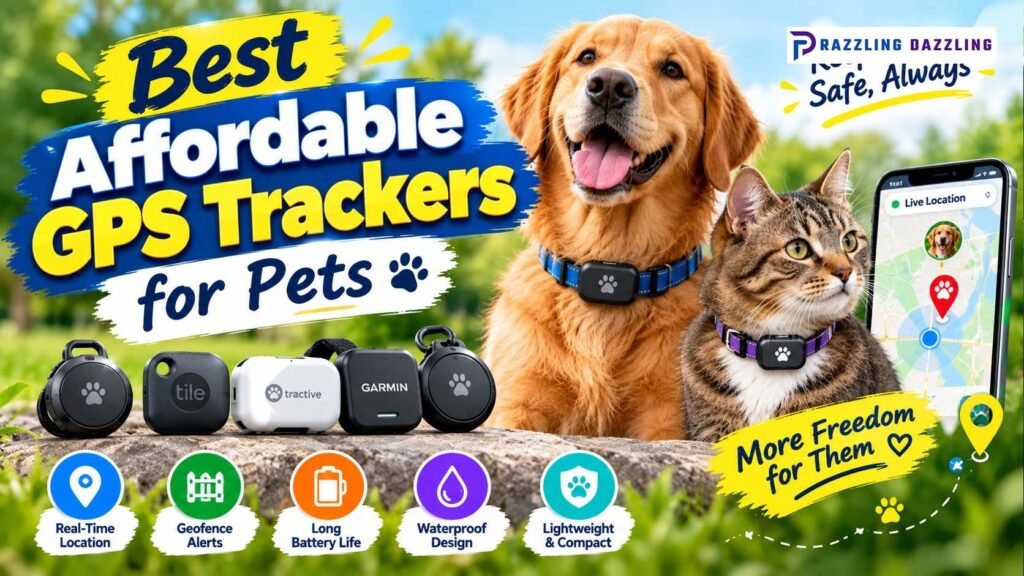
Losing a dog or cat is every pet owner’s nightmare. Whether your pet is an escape artist, loves exploring the neighborhood, or simply spends a lot of time outdoors, a GPS tracker can provide an extra layer of protection and peace of mind.
The good news is that you don’t necessarily need to spend hundreds of dollars to get useful pet-tracking technology. In 2026, there are several affordable GPS trackers for pets that offer features such as live location tracking, escape alerts, geofencing, activity monitoring, and smartphone apps.
However, choosing the right tracker isn’t as simple as picking the cheapest device. Some affordable trackers require a monthly or annual subscription, while others avoid recurring fees by using Bluetooth or radio-based technology. The difference is especially important because a Bluetooth tracker isn’t equivalent to a true GPS tracker with cellular connectivity.
Current 2026 comparisons commonly highlight Tractive, Fi, and Jiobit among dedicated GPS pet trackers, while products such as Apple AirTag are positioned as lower-cost alternatives rather than true live GPS systems.
In this guide, we’ll explain what to look for, how subscription costs affect the real price, and which type of tracker makes the most sense for your dog or cat.
What Is a GPS Pet Tracker?
A GPS pet tracker is a small device attached to your pet’s collar that uses location technology to help you determine where your pet is.
Dedicated cellular GPS trackers typically combine GPS positioning with cellular connectivity. GPS determines the device’s location, while the cellular network sends that information to your smartphone.
This means you can potentially check your pet’s location from a considerable distance, provided the tracker has compatible cellular coverage.
Some devices also offer:
- Live location updates
- Geofencing
- Escape alerts
- Location history
- Activity monitoring
- Battery notifications
- Multiple pet profiles
The exact features depend on the tracker and subscription plan.
GPS Tracker vs. Bluetooth Tracker: What’s the Difference?
This is one of the most important things to understand before buying.
A true GPS tracker can determine its location using GPS satellites and communicate that location through cellular networks.
Bluetooth trackers work differently.
Devices such as Apple AirTag use Bluetooth and a crowdsourced finding network rather than continuously transmitting their own GPS location. That’s why they’re generally inexpensive and don’t require a monthly tracking subscription, but they’re not a direct replacement for a cellular GPS pet tracker.
Choose a GPS tracker if:
- Your pet frequently travels outdoors
- You want live location tracking
- Your pet is an escape risk
- You want geofence alerts
- You need tracking over larger distances
Consider a Bluetooth tracker if:
- Your pet usually stays nearby
- You live in a densely populated area
- You want the lowest possible ongoing cost
- You primarily need a backup identification/finding tool
For a pet that could run several miles away, a true GPS tracker is generally the more appropriate technology.
What Makes a GPS Tracker Affordable?
The price displayed on the product page isn’t necessarily the total cost.
There are usually two costs to consider:
- Hardware cost: The amount you pay for the physical tracker or collar.
- Service cost: The subscription required for cellular connectivity, live tracking, and other cloud-based features.
For example, current 2026 comparisons put Tractive’s hardware around the $50–$80 range depending on model and pricing, with subscription plans adding to the long-term cost.
That means a tracker costing $50 upfront isn’t necessarily cheaper over three years than one costing $100–$150 with a different subscription structure.
Always compare the total cost of ownership, not just the initial purchase price.
Key Features to Look For
1. Live GPS Tracking
For an escape-prone pet, live tracking is arguably the most valuable feature.
Instead of simply seeing where your pet was last detected, you can monitor its current location through an app.
Some trackers can provide updates every few seconds while in live-tracking mode, although actual performance depends on cellular coverage, battery level, environment, and the specific device.
2. Geofencing
Geofencing allows you to establish a virtual safe zone around your home.
For example, you might create a boundary around your:
- House
- Yard
- Property
- Neighborhood
If your pet leaves that area, the app can send an alert.
This can be particularly useful for pets that frequently escape through open gates or damaged fences.
3. Battery Life
Battery life can make a major difference.
A tracker with excellent location accuracy isn’t particularly useful if you constantly forget to charge it.
Depending on the model, battery life can range from several days to several weeks or even months under certain usage conditions. Current comparisons show major differences between models, with Fi emphasizing particularly long battery life while smaller cellular trackers may need charging more frequently.
Before buying, consider:
- Normal tracking mode
- Live tracking runtime
- Charging time
- Low-battery alerts
- Battery-saving modes
4. Size and Weight
A tracker needs to be comfortable for your pet.
A device that’s perfectly reasonable for a large Labrador may feel bulky on a small cat or toy breed.
For smaller pets, compact options such as Jiobit can be especially attractive because of their lightweight design. Current comparisons identify Jiobit as a strong option for small dogs and cats.
Always check the manufacturer’s recommended pet size and weight before attaching a tracker.
5. Water Resistance
Dogs don’t always respect electronics.
Your pet may:
- Walk through puddles
- Play in wet grass
- Jump into water
- Get caught in the rain
A water-resistant or waterproof tracker is therefore highly desirable for outdoor pets.
6. Smartphone App
The app is essentially your control center.
A good app should make it easy to:
- View your pet’s current location
- Check location history
- Set safe zones
- Receive alerts
- Monitor battery status
- Manage multiple pets
A tracker with excellent hardware but a confusing app can quickly become frustrating.
Best Affordable GPS Tracker Types for Pets
Best Value for Most Dog Owners: Tractive
Tractive is frequently highlighted as a strong value option because the hardware has a relatively low entry price while providing true cellular GPS tracking.
Current 2026 comparisons describe its latest dog tracker as offering live tracking, broad coverage, and a battery life of roughly two weeks under suitable conditions.
It’s particularly appealing for:
- Medium and large dogs
- Escape-prone pets
- Owners who want live tracking
- People looking for relatively low hardware costs
The main drawback is the required subscription.
Best for Small Pets: Jiobit
Small dogs, puppies, and cats need a tracker that doesn’t become uncomfortable or interfere with normal movement.
Jiobit’s compact design makes it a notable option for smaller pets. Current comparisons list it at roughly 0.6 ounces (17 grams), making size one of its biggest advantages.
It also combines GPS with cellular, Bluetooth, and Wi-Fi positioning technologies.
The trade-off is that its ongoing subscription can make it more expensive over time than some alternatives.
Best for Long Battery Life: Fi Series 3+
Battery life is one of Fi’s biggest selling points.
Current 2026 sources report battery performance of up to around three months under certain usage conditions, although real-world runtime varies depending on tracking activity, network conditions, and usage patterns.
Fi is worth considering if:
- You don’t want to charge frequently
- Your dog spends a lot of time outdoors
- You want escape alerts
- Durability is important
The higher overall cost can make it less attractive for shoppers who are strictly focused on the lowest price.
Best No-Subscription Budget Option: Bluetooth Trackers
If your main goal is simply finding a pet that has wandered nearby, a Bluetooth tracker can be considerably cheaper.
Apple AirTag is a common example.
However, it’s important to understand the limitation: AirTag is not a true GPS tracker. It relies on Bluetooth and Apple’s Find My network rather than providing continuous cellular GPS tracking.
That makes it more suitable as a low-cost backup than as a replacement for a dedicated GPS tracker.
For example, if your dog runs into a remote area with few compatible devices nearby, a Bluetooth tracker may not provide the location information you’d expect from a cellular GPS device.
Are GPS Trackers Worth the Monthly Subscription?
For many pet owners, yes.
The subscription pays for the cellular connectivity that allows a tracker to communicate with your phone from outside your home’s Wi-Fi or Bluetooth range.
Without that cellular service, a true live GPS system generally cannot provide the same type of remote tracking.
The key is to think about the subscription as part of the tracker itself.
If you expect to use the device for several years, calculate:
Hardware price + subscription costs over your expected ownership period = true cost
A $50 tracker with a subscription may ultimately cost more than a $100 tracker with a cheaper service plan.
How to Choose a Tracker for Your Dog
For most dog owners, start with these questions:
Does your dog frequently escape?
If yes, prioritize live GPS tracking and geofencing.
Is your dog very active?
Choose a durable, water-resistant tracker with reliable battery life.
Is your dog small?
Prioritize weight and dimensions over maximum feature count.
Does your dog travel internationally?
Check the tracker’s supported countries and cellular coverage before buying.
Do you hate subscriptions?
Consider whether a Bluetooth or radio-based system is sufficient for your needs.
How to Choose a Tracker for Your Cat
Cats have different requirements from dogs.
A cat tracker should be:
- Lightweight
- Compact
- Comfortable
- Securely attached
- Water-resistant
- Long-lasting
For indoor-outdoor cats, a compact cellular GPS tracker can be valuable if you want to know where your cat goes.
For indoor cats that rarely leave the house, a simple Bluetooth tracker may be sufficient as a backup.
Don’t Forget the Collar and Identification Tag
A GPS tracker shouldn’t be your pet’s only form of protection.
Even if your tracker successfully locates your pet, someone who finds them may not know how to contact you.
A collar with an identification tag can provide your:
- Pet’s name
- Owner contact information
- Emergency phone number
Think of it this way:
The GPS tracker helps you find your pet. The ID tag helps someone return your pet.
Using both provides a stronger overall safety strategy.
Common Mistakes to Avoid
- Buying Based Only on the Device Price: Always calculate subscription costs.
- Assuming Every Tracker Uses GPS: Bluetooth trackers and GPS trackers are different technologies.
- Ignoring Pet Size: A bulky tracker can be uncomfortable for cats and small dogs.
- Forgetting Cellular Coverage: Cellular GPS trackers require compatible network coverage.
- Ignoring Battery Alerts: Enable low-battery notifications so you’re not caught off guard.
- Treating GPS as a Guarantee: No tracker can guarantee recovery. Battery level, cellular coverage, GPS reception, and the condition of the device can all affect tracking performance.
The best affordable GPS tracker for your pet isn’t necessarily the cheapest device you can buy. It’s the one that offers the right combination of price, tracking technology, battery life, size, durability, and ongoing service costs for your particular pet.
For many dog owners, a tracker such as Tractive offers a compelling balance between affordable hardware and true live GPS tracking. For smaller pets, Jiobit is worth considering because of its compact size. If battery life is your highest priority, Fi offers a much longer runtime but comes at a higher overall cost.
If you simply want an inexpensive way to locate a nearby pet and don’t need continuous GPS tracking, a Bluetooth tracker can be a useful low-cost alternative—but understand its limitations before relying on it as your primary safety device.
Ultimately, the best approach is to choose based on how your pet behaves, how far they might travel, how often you’re willing to charge the device, and how much you’re comfortable spending over the long term.
Why Trust Razzling Dazzling?
At Razzling Dazzling, we’re dedicated to helping readers discover useful technology, home products, and lifestyle solutions with confidence.
Our goal is to make complicated buying decisions easier by focusing on the features that actually matter in everyday use. Rather than simply repeating product specifications, we look at practical considerations such as usability, value, performance, durability, and long-term ownership.
From smart pet technology and home gadgets to the latest consumer electronics, Razzling Dazzling provides straightforward guides designed to help you shop smarter and live better.
We believe good information should be clear, honest, and accessible to everyone.
Frequently Asked Questions
What is the most affordable GPS tracker for pets?
The most affordable true GPS tracker depends on the subscription plan and your pet’s needs. Current 2026 comparisons frequently identify Tractive as a strong budget-oriented option because of its relatively low hardware cost and live cellular GPS tracking.
Is there a GPS pet tracker with no monthly fee?
Yes, but the options work differently. Some subscription-free devices use Bluetooth or radio technology rather than cellular GPS. For example, AirTag has no monthly service fee but is not a true live GPS tracker. Dedicated radio/GPS systems can also avoid cellular subscriptions but tend to have much higher upfront costs.
Is an AirTag good enough for a dog?
An AirTag can be useful as a low-cost backup, particularly in areas with many Apple devices nearby, but it shouldn’t be considered equivalent to a dedicated cellular GPS tracker. AirTag relies on Bluetooth and the Find My network rather than continuous cellular GPS tracking.
Do GPS pet trackers require a subscription?
Most cellular GPS pet trackers require a subscription because the device needs cellular connectivity to send location information to your smartphone. Tractive, Fi, and Jiobit are examples of trackers that use subscription-based services.
How long does a pet GPS tracker battery last?
Battery life varies significantly. Some trackers last around a week or two, while models such as Fi can offer substantially longer battery life under suitable conditions. Live tracking and poor cellular conditions can reduce runtime.
Can GPS trackers work for cats?
Yes. Several trackers are specifically designed for cats or small pets. Size and weight are especially important because a device that works comfortably for a large dog may be too bulky for a cat.
Can a GPS tracker find my pet anywhere?
No tracker can guarantee coverage everywhere. Cellular GPS trackers depend on compatible cellular coverage, while Bluetooth trackers depend on nearby compatible devices. Remote areas can therefore present challenges.
Should I use both a GPS tracker and an ID tag?
Yes. A GPS tracker can help you locate your pet, while a traditional identification tag gives someone who finds your pet a simple way to contact you. Using both provides complementary protection.
Ready to give your pet an extra layer of protection? Explore more pet technology guides, smart gadgets, and practical product recommendations from Razzling Dazzling. Compare the features that matter, understand the real cost of ownership, and choose technology that fits your lifestyle and your pet’s needs.
Bookmark Razzling Dazzling and check back regularly for updated buying guides, product reviews, and the latest tech recommendations.