
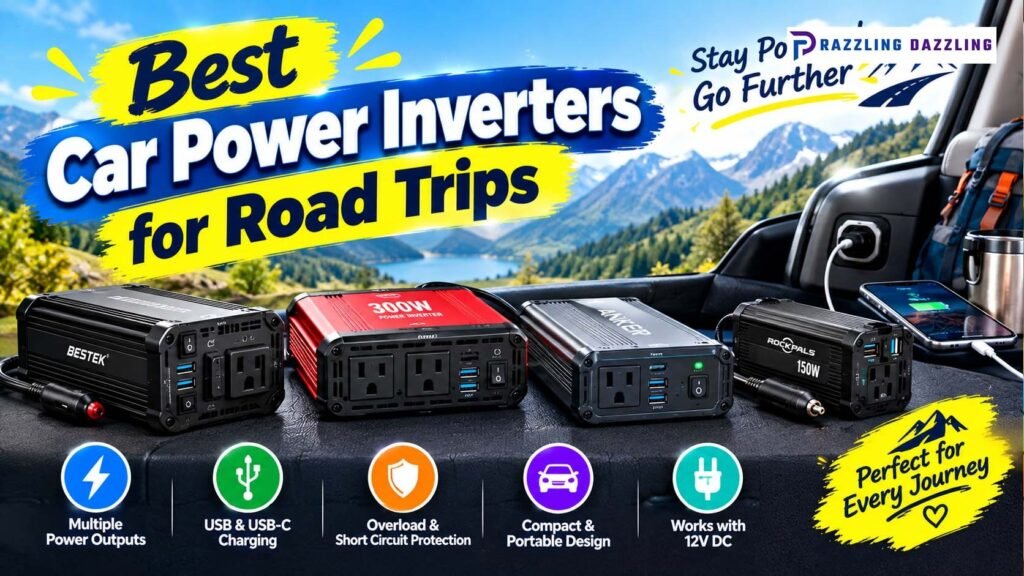
Long road trips are much easier when you can keep your essential electronics charged. Whether you’re traveling with a laptop, smartphone, tablet, camera, gaming device, or other equipment, a car power inverter can turn your vehicle into a convenient mobile charging station.
Unlike a standard USB car charger, a power inverter can convert your vehicle’s 12V DC power into household-style AC power, allowing you to connect devices that use a conventional wall plug.
However, choosing the right inverter isn’t simply about picking the model with the biggest wattage number. Your vehicle’s 12V outlet has its own electrical limit, and exceeding that limit can blow a fuse or potentially create a safety issue. Car and Driver’s 2026 testing specifically demonstrated why checking the vehicle’s circuit capacity is important.
Here are some of the best car power inverters for road trips, along with what to look for before buying one.
Why Use a Car Power Inverter on a Road Trip?
A USB car charger works perfectly for smartphones and many other small devices, but it can’t power equipment that requires a standard AC plug.
A car power inverter gives you more flexibility for devices such as:
- Laptops
- Camera chargers
- Tablets
- Portable gaming devices
- Battery chargers
- Small electronics
- Some low-power appliances
For families or groups traveling together, multiple outlets can also make it easier for several passengers to charge their devices at the same time.
What to Look for in a Car Power Inverter
Wattage
Wattage is one of the most important specifications.
A 150W or 200W inverter may be more than enough for smartphones, tablets, cameras, and many laptops. A 300W model provides more flexibility, while larger loads may require a direct connection to the vehicle battery.
Don’t assume that an inverter’s advertised maximum wattage is automatically available through your car’s 12V socket. Car and Driver notes that a 20-amp, 12V circuit theoretically supports about 240W, and the actual safe limit depends on the vehicle’s wiring and fuse rating.
AC Outlets
If you’re traveling with multiple people, two AC outlets can be useful. You can charge a laptop while another passenger powers a camera charger or other device.
USB Ports
USB ports are another important feature because many devices don’t need an AC outlet at all.
A combination of AC outlets, USB-A, and USB-C can give you considerably more flexibility.
USB-C Power Delivery
USB-C PD is particularly useful for modern phones, tablets, and compatible laptops.
If most of your electronics use USB-C, look for an inverter with a dedicated USB-C PD port rather than relying entirely on AC outlets.
Safety Protection
Useful protection features include:
- Overload protection
- Over-temperature protection
- Short-circuit protection
- Over-voltage protection
- Low-voltage protection
- Fuse protection
These features can help protect both the inverter and connected equipment.
Cooling
Power inverters generate heat, particularly when operating close to their maximum capacity.
Make sure the inverter has adequate ventilation and never cover its cooling openings during use.
Best Car Power Inverters for Road Trips
1. Energizer 500W Power Inverter — Best Overall for Higher-Power Road Trips
The Energizer 500W Power Inverter is one of the strongest choices if you need more power and multiple charging connections during a road trip.
Car and Driver selected it as its Best Value power inverter in its 2026 testing. It features two 120V AC outlets and four USB ports, giving travelers plenty of options for charging multiple devices.
One important detail is that you need to connect the inverter directly to the vehicle battery using the included alligator clamps to access its full 500W capability. When connected through the cigarette-lighter socket, the available power is more limited.
During testing, it successfully handled multiple phones, tablets, and a battery charger, although a blender eventually caused its internal fuse to blow.
Best for: Road trips requiring multiple devices and higher power.
2. BESTEK 300W Power Inverter — Best Budget Option
The BESTEK 300W Power Inverter is a compact option for travelers who want traditional AC outlets without spending too much.
Car and Driver selected the BESTEK 300W as its Best Budget inverter in its 2026 testing. It includes two AC outlets and USB ports, making it useful for laptops, tablets, phones, and other everyday electronics.
However, this model also demonstrates why you shouldn’t rely solely on the inverter’s advertised wattage.
During testing, Car and Driver’s vehicle had a 20-amp circuit, while the inverter was rated for 300W. When the test load became too high, the vehicle’s fuse blew. The lesson is simple: always check your vehicle’s accessory outlet rating before using a high-load inverter.
Best for: Budget-conscious road trippers with moderate power requirements.
3. DeWalt 140W Power Inverter — Best Rugged Option
If durability and simplicity are more important than maximum power, the DeWalt 140W Power Inverter is an appealing choice.
Car and Driver named it its Best Rugged option in 2026. It features rugged construction, rubber grips, a thick power cord, two USB ports, and one 120V AC outlet.
Its 140W capacity means it’s better suited to lower-power electronics rather than demanding appliances.
The inverter also has a status indicator that shows when power is being supplied and provides a fault indication when there’s a problem.
Best for: Travelers who want a durable, compact inverter for basic electronics.
4. FOVAL 200W Car Power Inverter — Best Compact Choice
The FOVAL 200W Car Power Inverter is a practical choice for travelers who need AC outlets but don’t want to carry a large inverter.
Its 200W class makes it suitable for many common road-trip electronics, including laptops, tablets, phones, and camera chargers.
A compact inverter like this can fit easily into a glove compartment, center console, or travel bag when it’s not being used.
For passengers who primarily need to charge electronics rather than run appliances, 200W can provide a useful balance between capability and portability.
Best for: Couples, solo travelers, and families carrying several small devices.
5. FOVAL 150W Car Power Inverter — Best for Basic Charging
For simple charging needs, a 150W inverter can be all you need.
A model in this power range is particularly useful if your road-trip equipment consists mostly of phones, tablets, cameras, and a laptop charger.
There’s little reason to carry a much larger inverter if you’re never going to use the additional capacity.
Best for: Basic electronics and lightweight travel setups.
How Many Watts Do You Need?
The right wattage depends on what you plan to power.
If you’re primarily charging smartphones, tablets, cameras, and small electronics, a 150W–200W inverter may be sufficient.
For laptops and multiple devices, moving up to around 300W can provide additional flexibility.
For higher-power equipment, however, you shouldn’t simply buy the biggest inverter you can find and plug it into the cigarette-lighter socket.
Car and Driver’s testing measured an iPhone charger at 14W, an iPad charger at 14W, a Milwaukee battery charger at 90W, a blender at 290W peak, and a hair dryer at 547W peak.
This shows why small electronics and heating appliances are completely different categories when it comes to power requirements.
Can You Run a Laptop From a Car Power Inverter?
Yes. Many laptops can be powered by a properly rated car inverter.
Check the wattage printed on your laptop’s power adapter. If the charger requires 65W, for example, a properly rated 150W or 200W inverter should generally have sufficient capacity for the charger itself.
However, remember that the vehicle’s outlet has its own limitations.
If your laptop supports USB-C Power Delivery, a USB-C PD connection can be an even more convenient solution because it avoids converting DC to AC and then back to DC through the laptop charger.
Can You Run a Coffee Maker or Hair Dryer?
This is where many people make a mistake.
Coffee makers, hair dryers, kettles, heaters, and similar appliances can require substantially more power than phones or laptops.
Car and Driver measured a hair dryer at 547W peak during its testing. That’s far beyond what many standard 12V accessory outlets can safely provide.
For these types of appliances, a standard cigarette-lighter inverter may not be appropriate.
If you genuinely need high-power AC while traveling, a properly installed battery-connected inverter or a portable power station may be a better solution.
Car Inverter vs. Portable Power Station
A car inverter and portable power station solve similar problems in different ways.
A car inverter draws power from your vehicle’s electrical system and is especially useful while driving.
A portable power station contains its own rechargeable battery, allowing you to use AC power even when the vehicle is turned off.
A car inverter is generally better when you want an inexpensive way to power electronics while driving.
A portable power station makes more sense when you’re camping, spending extended periods away from the vehicle, or need to operate devices while the engine is off.
Current 2026 portable power-station options range from compact units designed for electronics to much larger battery systems capable of powering considerably more demanding equipment.
How to Safely Use a Car Power Inverter
Safety should always come before convenience.
Check the Vehicle’s Fuse Rating
Before using a high-power inverter, check your vehicle owner’s manual for the 12V outlet’s maximum rating.
Don’t assume that because an inverter says “300W” or “500W,” your vehicle’s accessory outlet can safely deliver that amount.
Don’t Install a Larger Fuse
If an inverter keeps blowing the vehicle’s fuse, don’t simply replace it with a higher-rated fuse.
Car and Driver specifically warns that the wiring itself is designed around the circuit’s rated capacity. Installing a larger fuse can create an electrical-fire risk rather than solving the underlying problem.
Use a Direct Battery Connection for Higher Loads
Some larger inverters include battery clamps because they are designed to draw substantially more power than a typical accessory socket can provide.
Follow the manufacturer’s installation instructions carefully.
Keep the Inverter Cool
Don’t place an inverter under clothing, luggage, or anything else that blocks ventilation.
Heat can build up quickly when an inverter is operating under heavy load.
Be Careful With the Vehicle Battery
Using an inverter while the engine is off can drain the vehicle’s battery.
For long periods of AC power away from the grid, a dedicated portable power station may be a better solution.
Common Mistakes to Avoid
When shopping for a car power inverter, avoid these mistakes:
- Choosing based only on maximum wattage: More power isn’t always better.
- Ignoring your vehicle’s electrical limits: Your 12V outlet may have a much lower limit than the inverter’s headline rating.
- Forgetting surge power: Some devices require more power when starting.
- Blocking ventilation: Heat is a major consideration with power inverters.
- Running high-power appliances from a small inverter: Appliances like hair dryers and kettles can quickly exceed the inverter or vehicle circuit’s capacity.
- Ignoring USB-C: Modern electronics increasingly rely on USB-C, so a USB-C PD port can make your setup more convenient.
What Is the Best Car Power Inverter for a Road Trip?
For most travelers, the best choice depends on the devices you’re planning to use.
If you need higher power and multiple outlets, the Energizer 500W stands out for its combination of ports and battery-connection flexibility.
If you want a more affordable option for everyday electronics, the BESTEK 300W is worth considering, provided you understand your vehicle’s outlet limitations.
If durability is your priority, the DeWalt 140W offers a rugged design for lighter loads.
For basic charging, a compact 150W or 200W inverter may actually be the smarter choice because you don’t need to carry unnecessary capacity.
The best car power inverter for road trips isn’t necessarily the most powerful model.
For smartphones, tablets, cameras, and many laptops, a compact 150W–200W inverter can be enough. A 300W model provides additional flexibility, while a 500W inverter can make sense for higher-demand equipment when it is connected to the vehicle battery correctly.
Car and Driver’s 2026 testing selected the Energizer 500W as Best Value, DeWalt 140W as Best Rugged, and BESTEK 300W as Best Budget among the models it tested.
Most importantly, don’t confuse the inverter’s maximum rating with what your vehicle’s 12V socket can safely deliver.
Choose an inverter based on your actual devices, check your vehicle’s electrical specifications, keep the inverter properly ventilated, and avoid overloading the circuit.
With the right setup, a car power inverter can make long road trips significantly more convenient by keeping your essential electronics powered wherever the road takes you.
Frequently Asked Questions
What is the best car power inverter for road trips?
The best option depends on your power requirements. The Energizer 500W is a strong choice for higher-power needs, while the BESTEK 300W and DeWalt 140W are better suited to different budget and durability requirements.
How many watts should a car power inverter have?
For phones, tablets, cameras, and many laptops, 150W–300W can be sufficient. Higher-power appliances may require a much larger inverter and a direct battery connection.
Can a car power inverter charge a laptop?
Yes. A properly rated inverter can power many laptops. Check your laptop charger’s wattage and make sure the inverter and vehicle circuit can safely handle the load.
Can a car inverter drain the battery?
Yes. An inverter draws electricity from the vehicle. Extended use while the engine is off can drain the starter battery.
Can I use a 500W inverter in a cigarette lighter?
Not necessarily. A 500W inverter may require direct connection to the vehicle battery to reach its full output. The vehicle’s 12V accessory socket may have a significantly lower electrical limit.
Is a 300W car inverter enough for a road trip?
For many road trips, yes. A 300W inverter can be useful for laptops, phones, tablets, cameras, and other relatively low-power electronics. However, always check your vehicle’s accessory circuit rating.
Is pure sine wave better for a car inverter?
Pure sine wave output can be preferable for sensitive electronics and certain demanding devices. Whether you need it depends on the equipment you’re powering and its manufacturer’s requirements.
What should I look for in a road-trip inverter?
Look for appropriate continuous wattage, adequate surge capacity, AC outlets, USB-A and USB-C ports, safety protections, good ventilation, suitable cable length, and compatibility with your vehicle.
Why Trust Razzling Dazzling?
At Razzling Dazzling, our goal is to help readers make smarter decisions about technology, automotive accessories, home products, and everyday gear.
Our team combines writers, technology enthusiasts, and everyday consumers with different backgrounds and real-world experience. We focus on clear, practical information that helps readers understand what a product does, where it fits, and what to consider before buying.
We believe in Honesty & Transparency, Practical Simplicity, Continuous Learning, and Inclusivity. Our goal isn’t simply to list products—we want to provide useful information that helps readers make confident decisions.