
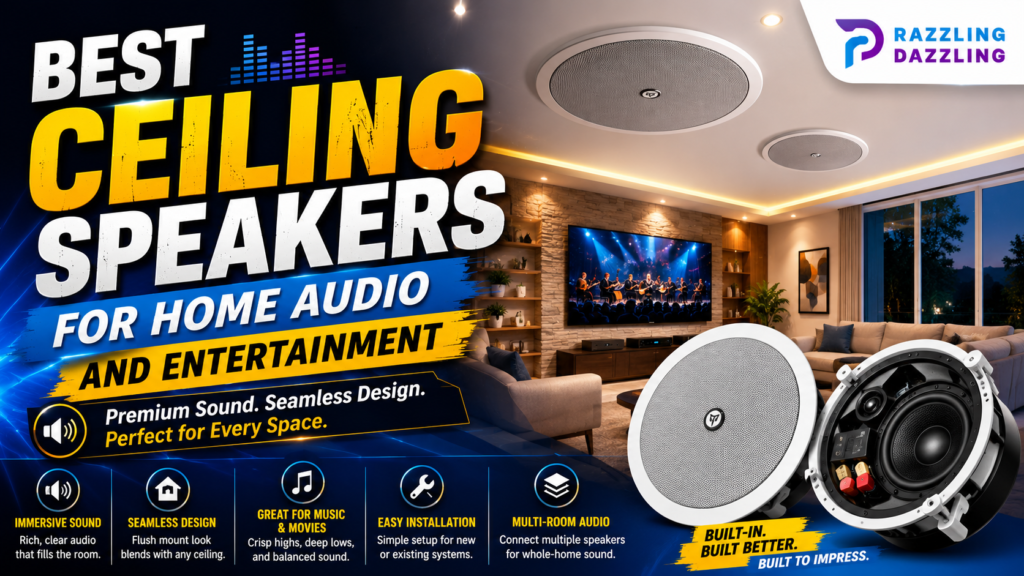
A good home audio system can completely change the way you enjoy music, movies, television, and entertainment. However, traditional speakers can take up valuable floor or shelf space and may not always match your home’s interior design. Ceiling speakers offer an attractive alternative by delivering sound from above while keeping the room looking clean and uncluttered.
The best ceiling speakers for home audio and entertainment can provide room-filling sound without requiring large cabinets around your living space. They can be used for background music, whole-home audio, home theater surround effects, and other entertainment applications. Current ceiling-speaker guides also emphasize that speaker placement and installation can be just as important as the speaker itself.
At Razzling Dazzling, we focus on practical technology guides that help readers understand products before making purchasing decisions. In this guide, we’ll explain what to look for when choosing ceiling speakers, how different types work, where to install them, and which features can make a difference in everyday listening.
What Are Ceiling Speakers?
Ceiling speakers, also called in-ceiling speakers, are audio speakers designed to be installed into a ceiling rather than placed on a shelf, stand, or floor.
Most traditional in-ceiling speakers are passive, meaning they receive their audio signal and power from an external amplifier or AV receiver. However, powered and wireless-oriented ceiling speaker systems are also available.
Their biggest advantage is their discreet appearance. Once properly installed, the speaker grille can sit nearly flush with the ceiling, allowing the audio equipment to blend into the room.
Ceiling speakers can be used for:
- Whole-home music
- Living room entertainment
- Kitchen audio
- Home theater effects
- Multi-room audio
- Background music
- Surround sound systems
The right design depends on what you want the system to accomplish.
Why Choose Ceiling Speakers for Home Audio?
One of the biggest reasons homeowners choose ceiling speakers is to save space.
Bookshelf and floor-standing speakers require dedicated locations, while ceiling speakers use space that would otherwise remain unused. This can be particularly useful in rooms where furniture placement or interior design makes traditional speakers inconvenient.
Ceiling speakers can also provide a broad listening experience. Instead of sound coming from a single point on the floor, multiple speakers can be distributed throughout a room for more consistent coverage.
For whole-home audio, the goal is generally even sound throughout the listening area rather than creating one extremely loud listening position.
Best Ceiling Speakers for Music
If your primary goal is listening to music, focus on sound quality and wide dispersion.
A good music-oriented ceiling speaker should provide balanced audio across vocals, instruments, and bass frequencies. Look for a model with a quality woofer and tweeter, particularly if you plan to use the speakers regularly rather than only for occasional background music.
Some premium ceiling speakers also include aimable or adjustable tweeters. These allow you to direct higher-frequency sound toward the listening area, which can be useful when the speaker cannot be installed directly above the ideal listening position.
Current ceiling-speaker recommendations include models specifically designed for music listening, while other models are optimized for home theater or moisture-prone environments.
Best Ceiling Speakers for Home Theater
Ceiling speakers can be an excellent addition to a home theater system, particularly for overhead or height effects.
In a Dolby Atmos setup, ceiling speakers can contribute to an immersive sound field by placing certain audio effects above the listener. For systems using four overhead speakers, placement is typically planned as a pair in front of the main listening position and another pair behind it.
However, ceiling speakers are not necessarily the ideal replacement for every front-channel speaker. Dedicated home theater designs often use appropriately positioned front and center speakers at the front of the room, with ceiling speakers serving height or overhead channels.
Before buying, decide whether you are building:
- A basic stereo music system
- A whole-home audio system
- A surround system
- A Dolby Atmos home theater
- A mixed music and movie setup
Your intended use should determine the type and number of speakers you need.
Speaker Size and Driver Configuration
Ceiling speakers are available in several sizes, commonly based on the diameter of their main woofer.
Larger drivers can potentially provide fuller bass and greater output, but size alone doesn’t determine sound quality. The design of the woofer, tweeter, crossover, enclosure, and overall speaker construction also matters.
A two-way ceiling speaker typically combines a woofer for lower and midrange frequencies with a separate tweeter for higher frequencies.
For general home entertainment, a two-way design can provide a useful balance of clarity and full-range sound.
When comparing models, look at the complete specification rather than choosing only by speaker diameter.
Aimable Tweeters Can Improve Sound
An aimable tweeter is a useful feature when speaker placement is not perfectly aligned with the listening position.
High frequencies are more directional than low frequencies. An adjustable tweeter lets you point some of that high-frequency energy toward the seating area.
This can be especially helpful in rooms with unusual layouts or when speakers must be installed in locations determined by ceiling joists, lighting, HVAC equipment, or other construction limitations.
The ability to adjust the tweeter does not eliminate the need for good placement, but it can provide additional flexibility.
Stereo-Input Ceiling Speakers
Some ceiling speakers are designed to reproduce both left and right stereo channels from a single speaker.
These are often called stereo-input or dual-voice-coil ceiling speakers.
They can be useful in smaller rooms or unusual spaces where installing a conventional left/right stereo pair is impractical.
For example, a single stereo-input speaker may work well in a small bathroom, hallway, or compact room where two separate speakers would not provide a meaningful stereo image.
For larger rooms, however, multiple appropriately positioned speakers can provide more consistent coverage.
Wireless vs. Wired Ceiling Speakers
When shopping for ceiling speakers, you’ll encounter both traditional wired systems and newer wireless or connected options.
Wired Ceiling Speakers
Traditional passive ceiling speakers connect to an amplifier or AV receiver using speaker wire.
Their advantages include:
- Reliable connection
- No speaker battery required
- Flexible amplifier selection
- Easy integration into home theater systems
- Potential for high-quality audio
The downside is that installation requires running speaker wire through the ceiling or walls.
Wireless or Connected Ceiling Speakers
Wireless ceiling audio systems can reduce the need for conventional audio connections between the speaker and source.
Some systems use Wi-Fi, Bluetooth, or integrated network audio technology. Modern whole-home audio products can also integrate with streaming platforms and multi-room systems.
However, “wireless” does not necessarily mean completely cable-free. A powered ceiling speaker may still require an electrical connection.
When comparing wireless systems, check how each speaker receives both power and audio.
What About Bluetooth Ceiling Speakers?
Bluetooth can be convenient for users who want to stream music directly from a compatible smartphone or tablet.
Bluetooth ceiling speakers can work well in smaller rooms, bedrooms, kitchens, and casual listening environments.
However, if you want synchronized audio across multiple rooms, a Wi-Fi-based multi-room system may offer more flexibility than a basic Bluetooth connection.
Think about how you plan to use the speakers before deciding which connectivity option makes the most sense.
Ceiling Speaker Placement Matters
Even excellent speakers can sound disappointing if they are installed poorly.
Speaker placement should be planned around the listening area rather than simply choosing the easiest location in the ceiling. Architectural speakers are difficult to move after installation, making planning particularly important.
For a basic stereo setup, the left and right speakers should be positioned so the main listening area is reasonably centered between them. Sonos recommends placing typical two-channel ceiling speakers around six to ten feet apart, while exact spacing should also take ceiling height and room layout into account.
For background music, several speakers may provide better coverage than trying to make two speakers cover a very large room.
Ceiling Height and Room Size
Room dimensions should influence your speaker selection and placement.
A small room may only need one stereo-input speaker or a single stereo pair. Larger rooms may benefit from multiple speakers distributed across the space.
Ceiling height also matters. As speakers are installed higher, sound coverage changes at the listener’s level.
Instead of assuming that a specific number of speakers will work for every room, consider the size, shape, furniture arrangement, ceiling height, and primary listening areas.
Moisture-Resistant Ceiling Speakers
If you’re installing speakers in a kitchen, bathroom, covered outdoor area, or another potentially humid environment, moisture resistance is worth considering.
Not every ceiling speaker is designed for damp conditions. Look for a model specifically rated or marketed for the environment where you plan to install it.
For example, current ceiling-speaker recommendations include models specifically identified as moisture-resistant.
Always follow the manufacturer’s installation and environmental guidelines.
Installation Considerations
Installing ceiling speakers requires more planning than placing a conventional speaker on a shelf.
Before cutting into the ceiling, identify the exact installation locations and check for potential obstructions.
These may include:
- Electrical wiring
- Plumbing
- HVAC ducts
- Ceiling joists
- Insulation
- Other structural components
Installation guides recommend checking the ceiling cavity and identifying obstructions before creating the speaker opening.
If you’re unfamiliar with electrical or ceiling work, professional installation can help prevent damage and ensure the speakers are mounted securely.
Use the Right Speaker Wire
For traditional passive ceiling speakers, appropriate speaker wire is an important part of the installation.
When running cable through walls or ceilings, use wire that is approved for in-wall installation in your region. Crutchfield, for example, recommends UL-rated CL2 or CL3 wire for suitable in-wall or in-ceiling runs.
The appropriate wire specification can vary based on local building codes and installation conditions, so always verify requirements before beginning the project.
How Many Ceiling Speakers Do You Need?
There is no universal number.
A small room may work well with a pair of speakers. A larger open-plan area may benefit from several speakers distributed across the room.
For whole-home audio, multiple speakers can help maintain more even volume as people move around the space.
If your objective is home theater, speaker count should be based on the specific surround format you’re building.
For example, an Atmos system can use overhead speakers as part of its height channels. The number and placement should follow the recommended layout for your receiver and speaker configuration.
Ceiling Speakers for Whole-Home Audio
Whole-home audio is one of the strongest use cases for ceiling speakers.
Instead of placing a large speaker in every room, you can install discreet speakers overhead and connect them to a multi-zone audio system.
This approach can provide music in spaces such as:
- Living rooms
- Kitchens
- Bedrooms
- Hallways
- Home offices
- Dining areas
The goal is generally consistent and comfortable sound rather than extremely high volume.
A properly planned system can allow different rooms or zones to play different audio while maintaining a clean interior appearance.
Bass Performance and Subwoofers
Ceiling speakers can produce useful bass, but their performance depends on driver size, speaker construction, installation conditions, and available enclosure volume.
If you want powerful low-frequency performance for movies or music, consider adding a dedicated subwoofer.
A subwoofer can handle deep bass while ceiling speakers focus on midrange and high-frequency information.
This combination can be particularly effective in home theater systems.
Paintable Grilles and Interior Design
One major advantage of ceiling speakers is their ability to blend into the room.
Many models feature removable grilles that can be painted to match the ceiling. This allows the speaker to become less visually noticeable.
However, always follow the manufacturer’s instructions before painting a speaker grille. Improper paint application can affect the grille material or speaker performance.
Common Mistakes to Avoid
Installing Speakers Without Planning: Avoid cutting holes before checking the ceiling cavity and planning the listening layout.
Focusing Only on Price: The least expensive speaker isn’t always the best value. Consider construction quality, sound performance, installation requirements, and intended use.
Choosing Based Only on Wattage: Power ratings are only one part of the equation. Speaker sensitivity, impedance, amplifier compatibility, and room size also matter.
Ignoring Moisture: Don’t install a standard indoor speaker in a location where moisture exposure could exceed its design specifications.
Placing Speakers Too Far Apart: Excessive spacing can create areas where music sounds too quiet or uneven. Proper coverage is more important than minimizing the number of speakers.
Forgetting the Amplifier: Passive ceiling speakers need an appropriate amplifier or AV receiver. Make sure the components are compatible before purchasing.
How to Choose the Best Ceiling Speakers for Your Home
Before buying, ask yourself a few simple questions.
What will I use them for?
Music, movies, background audio, or whole-home entertainment?
How large is the room?
Larger rooms may need additional speakers.
Where will the speakers be installed?
Consider ceiling height, structural limitations, and listening positions.
Do I need moisture resistance?
This is particularly important for bathrooms and other humid areas.
Do I want wired or wireless connectivity?
Your existing equipment and preferred listening method can guide this decision.
Do I need an amplifier?
Most passive ceiling speakers require an external amplifier or compatible AV receiver.
Will I need adjustable tweeters?
They can be helpful when the ideal speaker position isn’t directly aligned with the seating area.
The best ceiling speakers for home audio and entertainment should provide a combination of sound quality, appropriate coverage, reliable construction, and compatibility with your existing audio equipment.
For casual music listening, focus on balanced sound and broad coverage. For home theater, pay closer attention to speaker placement and compatibility with your surround-sound format. For kitchens and bathrooms, moisture resistance can be particularly important.
Most importantly, don’t overlook installation. Good speakers placed in the wrong locations can deliver disappointing results, while thoughtful placement can help a quality speaker system perform at its best.
At Razzling Dazzling, we believe choosing technology shouldn’t feel complicated. By understanding your room, listening habits, connectivity requirements, and installation options, you can make a more informed decision and build a home audio system that fits your lifestyle.
Frequently Asked Questions
1. Are ceiling speakers good for home audio?
Yes. Ceiling speakers can work very well for background music, whole-home audio, and certain home theater applications. Proper placement and suitable amplification are important for good results.
2. What are the best ceiling speakers for music?
The best model depends on your room and listening preferences. Look for balanced sound, good dispersion, appropriate driver size, and an aimable tweeter if flexible positioning is important.
3. Do ceiling speakers need an amplifier?
Most traditional passive ceiling speakers require an external amplifier or AV receiver. Some powered or connected models have amplification built in.
4. Are ceiling speakers good for home theater?
Yes. Ceiling speakers are commonly used for overhead or height channels in home theater systems, including Dolby Atmos configurations. The correct placement depends on the specific theater layout.
5. How far apart should ceiling speakers be?
Spacing depends on the room, ceiling height, speaker design, and intended use. For a typical two-channel setup, Sonos suggests around six to ten feet between speakers while also considering the main listening position.
6. Can ceiling speakers be used in a bathroom?
Some can. Choose speakers specifically designed or rated for moisture-prone environments and follow the manufacturer’s installation requirements.
7. Are wireless ceiling speakers better than wired speakers?
Neither is automatically better. Wired speakers can provide reliable connections and flexible amplifier integration, while wireless or connected systems can offer easier streaming and multi-room functionality.
8. Can ceiling speaker grilles be painted?
Many ceiling speaker grilles are designed to be paintable, but you should follow the manufacturer’s instructions to avoid affecting the grille or speaker performance.
9. Do ceiling speakers have good bass?
They can provide useful bass, but performance varies by speaker design, driver size, installation, and room. For powerful deep bass, adding a dedicated subwoofer may be beneficial.
10. What should I consider before installing ceiling speakers?
Consider room size, ceiling height, listening positions, speaker spacing, structural obstructions, wiring, amplifier compatibility, and moisture exposure. Planning before cutting the ceiling is essential.
Upgrade Your Home Audio Experience with Razzling Dazzling
Ready to create a cleaner and more immersive audio setup? Start by evaluating your room size, listening areas, speaker placement, and existing audio equipment. Then compare ceiling speakers based on sound quality, driver design, connectivity, moisture resistance, and installation requirements.
Explore more practical technology guides from Razzling Dazzling for helpful product insights, buying advice, and smart solutions that make everyday life simpler, smarter, and more enjoyable.