
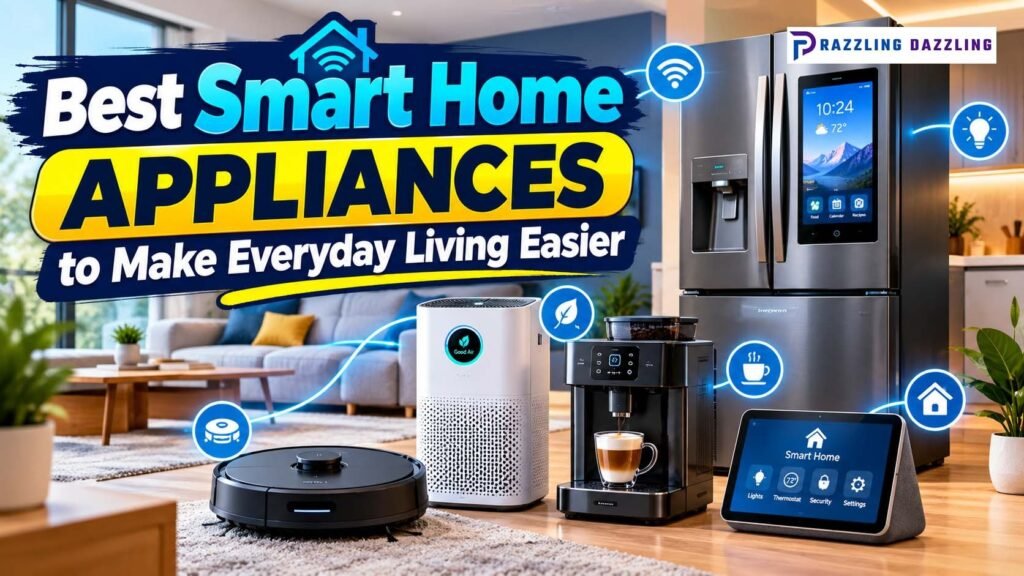
Smart home appliances are changing the way people manage everyday household tasks. Instead of simply performing one function, modern connected appliances can communicate with smartphones, provide alerts, automate routines, monitor usage, and sometimes adjust their operation based on schedules or household conditions.
From smart refrigerators that can notify you when a door is left open to connected washing machines that let you start or monitor a cycle remotely, these appliances can save time and reduce the number of small tasks homeowners need to remember. ENERGY STAR notes that connected appliances can provide features such as remote management, scheduling, energy-use information, and alerts while also offering the efficiency benefits of certified appliances.
However, buying smart does not simply mean choosing the appliance with the most features. The best smart home appliances should provide useful automation, reliable performance, easy controls, and compatibility with the smart-home ecosystem you already use.
What Are Smart Home Appliances?
Smart home appliances are household appliances that include connected technology, allowing them to communicate through Wi-Fi or another supported connection.
Depending on the product, you may be able to control or monitor an appliance through:
- A smartphone app
- Voice assistants
- A smart-home platform
- Automated schedules
- Sensors
- Remote notifications
- Energy-management systems
Smart functionality varies significantly between categories. A smart refrigerator may provide temperature and door alerts, while a smart washing machine may let you schedule laundry or receive cycle notifications.
ENERGY STAR identifies connected functionality across categories including refrigerators, clothes washers, dryers, dishwashers, room air conditioners, lighting, and smart thermostats.
Why Choose Smart Appliances for Your Home?
The biggest advantage of smart appliances is convenience. They can take over repetitive tasks, remind you about household issues, and allow you to monitor appliances when you are away.
Save Time on Everyday Tasks
Smart appliances can reduce the amount of manual work involved in household routines. Scheduling laundry, checking an appliance’s status, or receiving an alert can make everyday chores easier.
Control Appliances Remotely
Remote control is particularly useful when you forget to turn something off or want to check the status of an appliance while away from home.
For example, connected air conditioners can be controlled from a smartphone, while smart refrigerators can provide alerts when their doors are left open.
Create Automated Routines
Automation is one of the most useful parts of a smart home. Appliances can be scheduled to perform certain tasks at specific times.
This can be especially helpful for laundry, dishwashing, climate control, and lighting.
Monitor Energy Usage
Some connected appliances provide energy-use information, helping homeowners understand how much electricity different devices consume.
ENERGY STAR’s smart-home guidance emphasizes scheduling, energy monitoring, occupancy-based automation, and other tools for managing household energy use.
Best Smart Home Appliances for Everyday Living
1. Smart Refrigerator
A smart refrigerator can be one of the most useful connected appliances in a modern kitchen.
Basic smart features may include temperature monitoring, door-open alerts, remote settings, internal cameras, grocery-management features, and integration with other smart-home services.
Some newer models also include large displays for recipes, calendars, grocery lists, and other household functions. Good Housekeeping’s 2026 testing of smart refrigerators evaluated factors including Wi-Fi setup, app functionality, notifications, ecosystem compatibility, and display usability.
A smart refrigerator is especially useful for busy households where food management and kitchen organization are important.
Look for: Wi-Fi connectivity, reliable temperature controls, door alerts, useful mobile apps, energy efficiency, and easy-to-use controls.
2. Smart Washing Machine
Laundry is one of the household chores where automation can make a noticeable difference.
Smart washing machines can provide cycle notifications, remote controls, scheduling, maintenance alerts, and customized washing programs. Some models can also communicate with compatible dryers to help coordinate laundry cycles.
ENERGY STAR notes that connected clothes washers can provide remote management and scheduling functionality while certified models are designed to meet energy-efficiency requirements.
For families that do laundry frequently, smart controls can make it easier to keep track of loads without repeatedly checking the machine.
Look for: App controls, cycle notifications, scheduling, load sensors, energy efficiency, and automatic maintenance reminders.
3. Smart Dryer
A smart dryer can make the second half of laundry easier.
Connected dryers may allow users to monitor cycles remotely, receive notifications, and use sensors to determine when clothes are dry. ENERGY STAR specifically highlights sensor-based drying as a way connected dryers can automatically adjust cycle operation and stop when clothes are dry.
This can help avoid unnecessary drying time and make laundry routines more convenient.
Look for: Moisture sensors, automatic shutoff, remote notifications, cycle customization, and energy-efficient operation.
4. Smart Dishwasher
A smart dishwasher can simplify another repetitive household task.
Depending on the model, connected features may include remote monitoring, cycle notifications, scheduling, maintenance alerts, and energy-management functionality.
ENERGY STAR identifies connected dishwashers as one of the appliance categories where smart functionality can support convenience and energy management.
For households that run the dishwasher frequently, scheduling can also be useful when electricity rates vary by time.
Look for: Flexible cycles, leak alerts, remote monitoring, scheduling, efficient water use, and reliable cleaning performance.
5. Smart Oven and Range
Smart cooking appliances can make meal preparation more convenient.
Depending on the model, smart ovens may offer remote monitoring, cooking notifications, temperature monitoring, recipe assistance, and integration with smartphone apps.
Some connected ovens can help users keep track of cooking progress without repeatedly checking the kitchen.
However, convenience should not replace safe cooking practices. Smart controls should be treated as an additional feature rather than a reason to leave cooking appliances unattended.
Look for: Accurate temperature control, useful cooking modes, reliable notifications, easy cleaning, and a well-designed app.
6. Smart Air Conditioner
Smart air conditioners can be particularly useful in homes where cooling represents a significant part of electricity use.
A connected AC can allow users to adjust temperature remotely, create schedules, and sometimes use sensors or automation to manage operation.
ENERGY STAR specifically identifies smart thermostats and connected room air conditioners as useful tools for managing energy consumption.
For hot climates, smart cooling controls can be valuable because they make it easier to avoid running the system unnecessarily when nobody is home.
Look for: Scheduling, remote control, energy monitoring, sleep modes, temperature sensors, and compatibility with your preferred smart-home platform.
7. Smart Thermostat
A smart thermostat is one of the most practical smart-home devices for controlling heating and cooling.
Unlike a traditional thermostat, a smart model can learn or follow schedules, provide energy feedback, and adjust settings remotely.
ENERGY STAR requires certified smart thermostats to provide scheduling and energy-related feedback, while certified models must also meet defined energy-saving criteria based on real-world data.
For homes with compatible HVAC systems, this can make temperature management much easier.
Look for: HVAC compatibility, scheduling, occupancy sensing, energy reports, remote control, and reliable connectivity.
8. Robot Vacuum
A robot vacuum is not always considered a traditional major appliance, but it can be one of the most convenient smart cleaning devices.
Modern robot vacuums can automatically clean floors according to schedules and, depending on the model, map rooms, recognize areas, avoid obstacles, and return to their charging stations.
Some advanced models combine vacuuming and mopping, making them useful for maintaining hard floors and certain types of surfaces.
For busy households, scheduled cleaning can reduce the need to manually vacuum every day.
Look for: Reliable navigation, room mapping, scheduling, strong cleaning performance, automatic charging, and easy maintenance.
9. Smart Air Purifier
Indoor air quality is another area where connected technology can be useful.
Smart air purifiers can monitor air conditions and allow users to adjust settings through an app. Some models can automatically increase or decrease fan speed when sensors detect changes in air quality.
A good smart air purifier should offer useful filtration and reliable air-quality monitoring rather than relying only on connectivity.
Look for: Appropriate filtration, air-quality sensors, automatic modes, replacement-filter notifications, and low operating noise.
10. Smart Coffee Maker
For households where coffee is part of the daily routine, a connected coffee maker can add convenience through scheduling and app-based controls.
Instead of manually starting the brewing process every morning, some smart models allow users to schedule when coffee should be prepared.
The benefit is relatively simple, but it can make a daily routine more convenient.
Look for: Scheduling, easy cleaning, temperature control, app reliability, and compatibility with your smart-home system.
How to Choose the Best Smart Home Appliances
Buying several connected appliances at once can become expensive, so it is better to prioritize the features that provide real value.
Consider Your Daily Routine
Think about which household tasks consume the most time.
If laundry is your biggest chore, start with a smart washer and dryer. If temperature control is the main concern, consider a smart thermostat or connected AC.
Check Smart-Home Compatibility
Before purchasing an appliance, check whether it works with the smart-home platform you already use.
A collection of appliances that cannot communicate effectively with your existing ecosystem can make your home more complicated rather than simpler.
Prioritize Useful Features
Not every smart feature is worth paying extra for.
Remote monitoring, scheduling, maintenance notifications, energy information, and automation can provide genuine value. Decorative displays or unnecessary connected features may not.
Consider Energy Efficiency
Smart functionality should not be the only purchasing criterion. Look at the appliance’s underlying efficiency as well.
ENERGY STAR recommends certified products because they meet established energy-efficiency specifications. Its connected-appliance guidance also notes that smart functionality can provide additional opportunities for energy management.
Check App Quality
A smart appliance is only as useful as its controls.
Look for an app that is easy to navigate, provides useful notifications, and gives you meaningful control rather than simply adding connectivity for marketing purposes.
Think About Long-Term Support
Smart appliances depend partly on software. Before buying, consider the manufacturer’s reputation for maintaining apps, firmware, and connected services.
A reliable appliance should remain useful even if internet connectivity is temporarily unavailable.
Smart Appliances and Energy Savings
Smart appliances can help manage energy, but connectivity alone does not guarantee lower electricity bills.
The real benefit comes from using smart features intelligently.
For example, scheduling appliances to operate during appropriate times can help households avoid unnecessary operation. Some connected systems can also provide energy-use information and automate settings based on schedules or occupancy.
ENERGY STAR’s Smart Home Energy Management Systems program focuses on coordinated control of smart thermostats, lighting, and plug loads, with additional products able to be incorporated into the system.
In other words, the goal should not simply be to own more smart devices. The goal is to build a home where connected devices work together to reduce unnecessary work and energy use.
Are Smart Appliances Worth the Extra Cost?
Smart appliances can be worth the additional cost when the connected features solve a real problem.
For example, remote monitoring may be valuable for a washing machine, while scheduling may be useful for a dishwasher. A smart thermostat can provide ongoing value by making temperature management easier.
However, paying substantially more for features you will rarely use may not make sense.
Before buying, ask:
- Will I use the smart features regularly?
- Does the appliance solve a real household problem?
- Is the appliance energy efficient?
- Does it work with my existing ecosystem?
- Is the app reliable and easy to use?
- Will the appliance still work normally without internet access?
These questions can help you distinguish genuinely useful smart appliances from products that are simply connected.
Tips for Building a Smarter Home
You do not need to replace every appliance at once.
Start with one or two products that can make the biggest difference. A smart thermostat, robot vacuum, connected washer, or smart refrigerator can be a good starting point depending on your needs.
After that, build gradually.
Use consistent smart-home platforms where possible, keep device software updated, secure your accounts with strong passwords, and review the permissions requested by appliance apps.
It is also worth keeping your home Wi-Fi network reliable because many smart appliances depend on wireless connectivity for remote features.
A smart home should make everyday life simpler—not create another complicated system that requires constant management.
The best smart home appliances to make everyday living easier are not necessarily the products with the largest screens or the most advanced specifications. The best choices are appliances that combine dependable everyday performance with smart features that genuinely save time, improve convenience, or help manage energy.
Smart refrigerators can simplify food management, connected washers and dryers can make laundry easier, smart dishwashers can automate cleaning routines, and smart thermostats can improve temperature management. Robot vacuums and air purifiers can also reduce repetitive household tasks.
ENERGY STAR’s current guidance shows that connected appliances can offer useful capabilities such as remote management, scheduling, energy reporting, and automated operation.
Frequently Asked Questions
1. What are the best smart home appliances for everyday living?
Some of the most useful smart home appliances include smart refrigerators, washing machines, dryers, dishwashers, ovens, air conditioners, thermostats, robot vacuums, and air purifiers. The best choice depends on which household tasks you want to automate or simplify.
2. Are smart home appliances worth buying?
Smart appliances can be worth buying when their connected features provide useful benefits such as remote control, scheduling, notifications, automation, or energy monitoring. The value depends on how frequently you use those features.
3. Can smart appliances save electricity?
Smart appliances can help manage energy through scheduling, monitoring, automation, and more efficient operation. However, simply connecting an appliance to Wi-Fi does not automatically guarantee energy savings. ENERGY STAR recommends looking at certified energy efficiency alongside connected features.
4. What is the most useful smart appliance for a home?
There is no single best appliance for every household. Smart thermostats, robot vacuums, refrigerators, washing machines, and air conditioners can all provide significant convenience depending on your daily routines.
5. Do smart appliances work without Wi-Fi?
Many smart appliances continue performing their basic functions without an internet connection, although remote controls, notifications, cloud-based features, and some automation may not work. Check the manufacturer’s specifications before purchasing.
6. What should I look for when buying smart appliances?
Look for reliable performance, useful smart features, energy efficiency, smart-home compatibility, an easy-to-use app, strong security practices, and good long-term manufacturer support.
7. Can smart appliances work together?
Many smart appliances can work together when they support the same smart-home ecosystem or compatible communication standards. Compatibility should be checked before buying multiple connected products.
8. Should I replace all my appliances with smart models?
No. Replacing everything at once is usually unnecessary. Start with appliances that solve specific problems in your household and gradually add connected products when they provide meaningful convenience or efficiency benefits.
At Razzling Dazzling, we believe technology should make everyday life simpler, smarter, and more convenient. Instead of buying every connected device available, focus on appliances that fit your routine, work with your existing technology, and provide useful features you’ll actually use.