
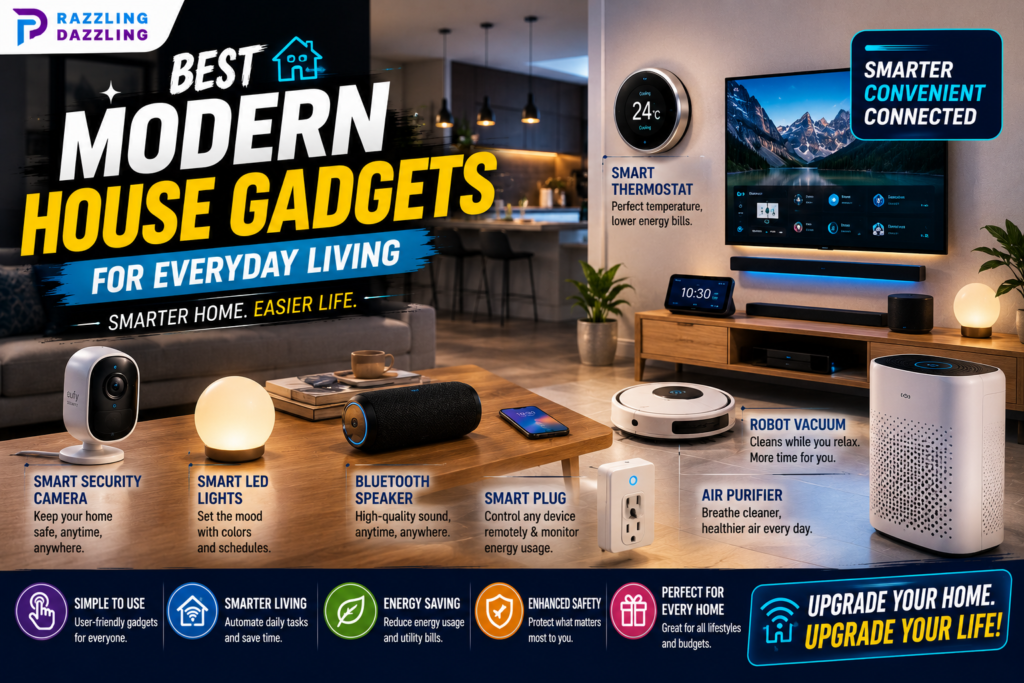
Modern homes are becoming more convenient, connected, and efficient. From lights that can follow a schedule to cleaning devices that handle routine chores, today’s modern house gadgets are designed to solve everyday problems rather than simply add more technology.
The best gadgets are the ones you’ll actually use. A useful smart plug can automate a simple appliance, a robot vacuum can reduce routine floor-cleaning work, and a smart display can provide a central way to interact with compatible devices. Current smart-home guides increasingly emphasize convenience, automation, security, and energy efficiency rather than technology for its own sake.
At Razzling Dazzling, we believe technology should make everyday life simpler and smarter. In this guide, we’ll explore useful modern house gadgets, what they do, and what to consider before bringing them into your home.
What Makes a Modern House Gadget Worth Buying?
Not every gadget advertised as “smart” is necessarily useful. A good household gadget should solve a real problem or make an existing task easier.
Before buying anything, ask yourself:
- Does it save time?
- Does it reduce repetitive work?
- Is it easy to operate?
- Will you use it regularly?
- Does it work with your existing devices?
- Is the ongoing maintenance reasonable?
- Does it provide useful features rather than unnecessary complexity?
The best modern home technology often focuses on small improvements that become valuable when used every day.
Smart Lighting for Better Everyday Convenience
Smart lighting is one of the easiest ways to modernize a home.
Smart bulbs and switches can allow you to control lighting from an app, voice command, schedule, or automation. Depending on the product, you may also be able to adjust brightness and color temperature.
For example, you could schedule bedroom lights to turn on gradually in the morning or have selected lights switch off automatically at bedtime.
Smart lighting can also be useful for creating different moods. A brighter setting can work well for studying or household tasks, while softer lighting can create a more relaxed environment.
Modern smart-home guides continue to identify smart lighting as one of the easiest entry points for people beginning to automate their homes.
Smart Plugs for Ordinary Appliances
A smart plug is a simple gadget that can add basic automation to compatible appliances.
Instead of replacing an existing device with an expensive smart version, you may be able to connect it through a compatible smart plug and control its power remotely or according to a schedule.
Potential uses include:
- Lamps
- Fans
- Decorative lighting
- Certain small household appliances
- Seasonal decorations
However, always check the smart plug’s electrical ratings and the appliance manufacturer’s requirements before using them together.
Smart plugs are especially useful for beginners because they can introduce automation without requiring major changes to the home.
Robot Vacuums for Automated Cleaning
Cleaning is one of the most repetitive household tasks, which makes robot vacuums a popular smart-home gadget.
Modern models can use sensors and navigation systems to move around rooms, detect obstacles, and clean according to schedules. Some advanced models can also return to charging stations and perform additional automated maintenance tasks.
Current smart-home coverage highlights robot vacuums as increasingly capable devices that can reduce routine floor-cleaning work.
When choosing one, consider:
- Floor types
- Navigation technology
- Battery life
- App quality
- Dustbin capacity
- Cleaning schedule options
- Obstacle detection
- Maintenance requirements
A robot vacuum isn’t completely maintenance-free, but it can reduce the amount of routine cleaning you need to do manually.
Smart Speakers for Music and Voice Control
A smart speaker can serve two purposes: entertainment and home control.
You can use compatible speakers to:
- Play music
- Set timers
- Ask general questions
- Create reminders
- Control compatible smart devices
- Build routines
The right ecosystem matters because smart speakers often work best with devices designed for the same platform.
For example, today’s smart-home ecosystems commonly include Amazon Alexa, Google Home, and Apple Home-related products. Some devices also support Matter, which is designed to improve interoperability between compatible smart-home products.
Smart Displays as Home Control Centers
A smart display combines a voice assistant with a screen.
Instead of receiving only an audio response, you may be able to see:
- Weather information
- Timers
- Calendar information
- Compatible camera feeds
- Recipes
- Music controls
- Smart-home controls
Current testing of smart displays highlights their usefulness as centralized control points for connected homes.
A display can be particularly useful in a kitchen, living room, or other high-use area.
Smart Security Cameras
Home security cameras have become another common category of connected household technology.
Depending on the model, cameras can provide features such as:
- Motion detection
- Night vision
- Mobile notifications
- Two-way audio
- Local or cloud storage
- Indoor or outdoor monitoring
For outdoor use, make sure the camera is specifically designed for outdoor conditions.
Privacy should also be an important consideration. Before installing a camera, understand how footage is stored, who can access it, and what privacy settings are available.
Video Doorbells
A video doorbell combines a doorbell with a camera and connected notifications.
Depending on the model, you may be able to see visitors, receive motion alerts, and communicate through two-way audio.
A video doorbell can be especially convenient when you’re away from the front door or unable to answer immediately.
Before buying one, check:
- Wired or battery-powered operation
- Wi-Fi requirements
- Video resolution
- Storage options
- Subscription requirements
- Existing doorbell compatibility
Smart Locks
Smart locks can provide alternative ways to manage access to your home.
Depending on the product, options may include:
- Smartphone access
- Keypad entry
- Temporary access codes
- Physical keys
- Automatic locking
Smart locks can be convenient, but security and compatibility should come before extra features.
Make sure the lock is compatible with your existing door and understand what happens if the battery loses power or the electronic system becomes unavailable.
Smart Thermostats and Climate Controls
Climate control is another area where automation can make a difference.
A compatible smart thermostat may allow you to schedule temperature settings and manage the system remotely.
Some smart-home platforms can also connect climate controls with other devices and routines.
Before purchasing a thermostat, verify that it is compatible with your heating and cooling system. Compatibility varies significantly between homes.
Air Purifiers for Cleaner Indoor Air
Air purifiers can be useful household appliances, particularly in rooms where people spend a lot of time.
Some modern models add smart features such as:
- Air-quality monitoring
- Automatic operating modes
- Smartphone controls
- Scheduling
- Filter reminders
A smart air purifier can provide useful information about indoor conditions while automating its operating schedule.
However, remember that filters require regular replacement or maintenance according to the manufacturer’s instructions.
Smart Humidifiers
A humidifier can add moisture to indoor air when conditions are dry.
Some modern models offer app controls, scheduling, humidity monitoring, and automatic operation.
If you choose a smart humidifier, ease of cleaning should be one of your priorities. Water-based appliances require appropriate maintenance to keep them operating properly.
Smart Kitchen Gadgets
The kitchen is one of the best places to use practical household technology.
Useful modern kitchen gadgets can include:
- Smart displays
- Programmable coffee makers
- Connected kitchen scales
- Smart thermometers
- Air fryers with digital controls
- Multi-function cooking appliances
The goal isn’t to make every kitchen appliance connected. Instead, choose gadgets that make cooking or preparation easier.
Multi-Function Cooking Appliances
A multi-function appliance can be particularly useful when counter space is limited.
Modern appliances can combine functions such as:
- Air frying
- Baking
- Roasting
- Reheating
- Dehydrating
- Cooking
Some newer smart cooking appliances also offer app connectivity and automated cooking functions.
Before buying, consider whether you’ll actually use the available functions. A smaller appliance that performs the tasks you need may be more practical than a large device filled with features you rarely use.
Smart Coffee Makers
For households that regularly prepare coffee, a programmable coffee maker can be a useful convenience gadget.
Depending on the model, features may include:
- Scheduling
- Temperature control
- Smartphone management
- Automatic brewing
- Custom drink settings
The most valuable feature is usually the ability to make your routine more convenient.
Smart Sensors
Small sensors can quietly improve a connected home.
Depending on the type, sensors can monitor:
- Motion
- Doors and windows
- Temperature
- Humidity
- Water leaks
- Light levels
A sensor can also trigger an automation.
For example, a motion sensor could activate hallway lighting when someone enters the area, provided the devices are compatible.
Water Leak Sensors
Water leaks can cause significant household problems, making leak detection a practical use of connected technology.
A smart leak sensor can notify you when it detects moisture in a location where water shouldn’t normally be present.
Potential locations include:
- Under sinks
- Near washing machines
- Around water heaters
- Near plumbing fixtures
These small devices can be inexpensive compared with the potential inconvenience of an unnoticed leak.
Smart Smoke and Safety Devices
Connected safety devices can provide additional notification features.
Depending on the product and local requirements, smart smoke or carbon-monoxide alarms may provide alerts through a connected app.
However, connected features should supplement—not replace—properly installed and maintained safety equipment.
Always follow local safety requirements and manufacturer instructions.
Smart Blinds and Curtains
Automated blinds can make daily routines more convenient.
You can potentially schedule them to:
- Open in the morning
- Close in the evening
- Adjust according to routines
- Provide additional privacy
Some systems can also integrate with smart-home platforms.
Automated window coverings can be especially useful for hard-to-reach windows.
Smart Fans
Smart fans can provide remote controls, schedules, and sometimes voice integration.
For example, you might schedule a fan to operate during certain periods or control it without getting up.
As with any connected appliance, check compatibility and electrical requirements before purchasing.
Smart Home Energy Monitors
Energy-monitoring gadgets can help you understand how electricity is being used.
Depending on the device, you may be able to monitor:
- Overall household consumption
- Individual circuits
- Appliance usage
- Historical trends
The biggest benefit isn’t simply seeing numbers. It’s identifying patterns that can help you understand where energy is being used.
Smart Plugs With Energy Monitoring
Some smart plugs can measure the electricity consumption of connected devices.
This can help you identify appliances that consume more energy than expected.
For example, you might monitor a home-office setup or entertainment system and review its usage over time.
Smart Charging Stations
Modern homes often contain multiple devices that need charging.
A dedicated charging station can help organize:
- Phones
- Tablets
- Wireless earbuds
- Smartwatches
- Other compatible devices
A well-designed charging area reduces cable clutter and keeps frequently used devices in one location.
Wireless Charging Accessories
Wireless charging can make everyday device charging more convenient for compatible phones and accessories.
A charging stand can also make it easier to see notifications or use a phone while it’s charging.
However, make sure the charger is compatible with your device and uses appropriate charging standards.
Smart Home Hubs
As the number of connected gadgets grows, managing them individually can become inconvenient.
A compatible smart-home hub or platform can provide a centralized place to manage devices and create automations.
Matter is increasingly relevant because it is designed to help compatible smart-home products from different manufacturers work together more easily.
Before buying a hub, check which devices and ecosystems it supports.
Smart Home Gadgets for the Bedroom
The bedroom can benefit from technology focused on comfort rather than complexity.
Useful options include:
- Smart lighting
- Sunrise-style lighting
- Smart speakers
- Air purifiers
- Temperature sensors
- Smart blinds
- Charging stations
Keep the bedroom setup simple. Too many notifications and bright displays can make the space feel less relaxing.
Smart Home Gadgets for the Living Room
The living room is often the center of home entertainment and connected control.
Useful gadgets include:
- Smart speakers
- Smart displays
- Streaming devices
- Smart lighting
- Robot vacuums
- Smart plugs
- Security devices
The goal should be to improve entertainment and convenience without filling the room with unnecessary devices.
Smart Home Gadgets for the Kitchen
For the kitchen, prioritize gadgets that genuinely reduce effort.
Good options include:
- Smart displays
- Multi-function cooking appliances
- Programmable coffee makers
- Smart lighting
- Kitchen timers
- Leak sensors
- Connected scales
A smart display can be particularly useful because it can combine recipes, timers, music, and household controls in one device.
Smart Home Gadgets for the Bathroom
Bathrooms can benefit from smaller practical gadgets such as:
- Humidity sensors
- Motion-activated lights
- Smart exhaust controls
- Water leak sensors
- Connected scales
Moisture-resistant products should be selected carefully, and electrical devices should always be used according to their safety instructions.
How to Build a Modern Home Without Overspending
You don’t need to automate everything at once.
A better strategy is to start with the areas where technology can make the biggest difference.
- Start With One Problem: Maybe you’re tired of manually controlling lights or constantly cleaning floors. Choose a gadget that addresses that problem.
- Choose One Ecosystem: If you plan to expand your setup, consider compatibility before buying your first device.
- Add Devices Gradually: After learning how your first gadget works, add another device that complements it.
- Prioritize Useful Features: Don’t pay extra for features you won’t use.
- Check Compatibility: Look for compatibility with your phone, network, smart-home platform, and existing devices.
Common Mistakes When Buying Modern House Gadgets
- Buying Gadgets Just Because They’re Smart: A product isn’t automatically useful because it has an app.
- Ignoring Compatibility: Different ecosystems don’t always work together seamlessly.
- Forgetting Subscription Costs: Some security cameras and connected services require paid subscriptions for certain features.
- Ignoring Maintenance: Robot vacuums need cleaning, air purifiers need filter maintenance, and connected devices may require software updates.
- Buying Too Many Devices at Once: Start small and learn what actually improves your routine.
How to Choose the Best Modern House Gadgets
Before purchasing a gadget, consider these questions:
What problem does it solve?
The best gadgets have a clear purpose.
How often will I use it?
A gadget used every day can provide more practical value than one used once a month.
Does it work with my existing setup?
Check ecosystem and connectivity compatibility.
Is it easy to maintain?
Consider cleaning, batteries, filters, updates, and subscriptions.
Will it remain useful over time?
Choose products from established platforms with reasonable support and compatibility.
The best modern house gadgets for everyday living aren’t necessarily the most complicated or expensive products. They’re the devices that quietly make everyday routines easier.
Smart lights can simplify lighting control. Smart plugs can add basic automation to existing appliances. Robot vacuums can reduce routine cleaning work. Smart displays can provide convenient access to information and connected-home controls. Sensors can monitor conditions and trigger useful automations.
The modern smart home is increasingly about practical convenience rather than futuristic novelty. Current coverage of smart-home technology emphasizes devices that save time, simplify household tasks, improve security, and integrate into daily routines.
At Razzling Dazzling, our goal is to help you make informed technology and lifestyle decisions without unnecessary complexity. Whether you’re starting your first smart-home setup or upgrading an existing home, focus on gadgets that solve real problems and fit naturally into your everyday routine.
Frequently Asked Questions
1. What are the best modern house gadgets for everyday living?
Some of the most useful options include smart lights, smart plugs, robot vacuums, smart speakers, smart displays, security cameras, leak sensors, air purifiers, and connected kitchen appliances.
2. Are smart home gadgets worth buying?
They can be worthwhile when they solve a genuine household problem or save time. The value depends on how frequently you’ll use the device and whether it integrates well with your existing setup.
3. What is the easiest smart home gadget for beginners?
Smart bulbs and smart plugs are often easy starting points because they can add basic automation without requiring major changes to your home.
4. Do all smart home gadgets work together?
No. Compatibility varies between manufacturers and ecosystems. Matter is designed to improve interoperability between compatible smart-home products, but you should still verify compatibility before purchasing.
5. Can smart home gadgets save time?
Yes. Devices such as robot vacuums, automated lights, smart plugs, and scheduled appliances can reduce repetitive tasks and simplify everyday routines.
6. What smart gadget can help with home security?
Smart security cameras, video doorbells, compatible smart locks, motion sensors, and door or window sensors can provide useful security-related features.
7. Are smart home gadgets difficult to install?
Many consumer smart-home gadgets are designed for relatively simple setup, although installation difficulty varies. Devices involving electrical wiring or existing home systems may require professional installation.
8. Should I buy smart gadgets from the same brand?
Not necessarily, but staying within a compatible ecosystem can make setup and future expansion easier. Check supported platforms and standards before mixing products.
9. What should I consider before buying a smart home gadget?
Consider its purpose, compatibility, connectivity, privacy features, maintenance requirements, subscription costs, reliability, and whether you’ll actually use its features regularly.
10. How can I build a smart home on a budget?
Start with one or two useful gadgets, such as smart bulbs or smart plugs. Once you’re comfortable with the setup, gradually add devices that solve other household problems.
Ready to Make Your Home Smarter?
Start with one area of your home and identify a task you’d like to make easier. Choose a practical gadget, check its compatibility, and give yourself time to learn how it fits into your routine before adding more devices.
From smart lighting and connected security to automated cleaning and kitchen technology, the right upgrades can make your home more convenient without making it complicated.
Explore Razzling Dazzling for more smart-home guides, technology reviews, practical buying advice, and useful lifestyle ideas designed to help you live smarter every day.