
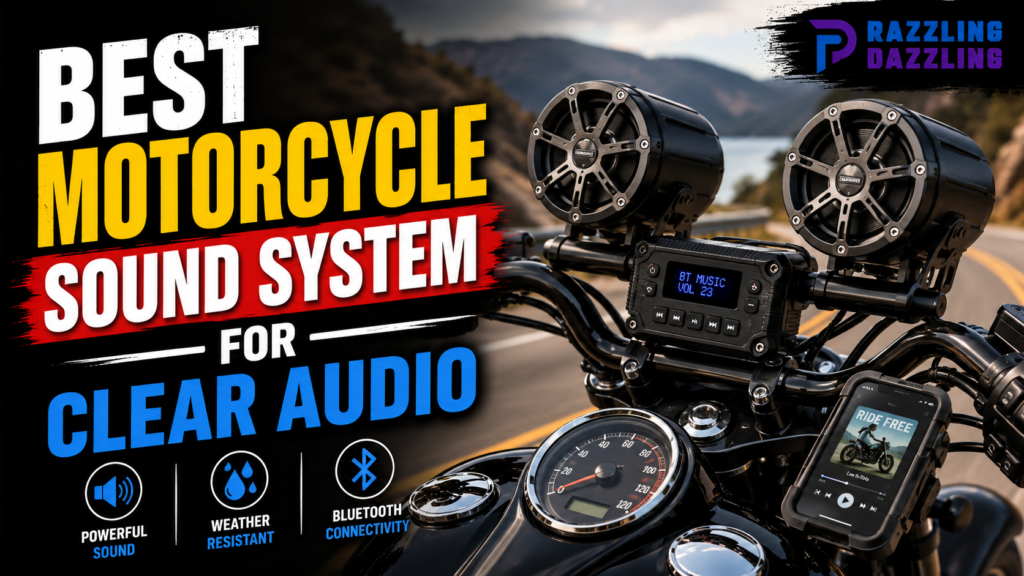
A motorcycle can be more than a way to get from one place to another. For many enthusiasts, it is also part of a lifestyle that includes touring, outdoor gatherings, motorcycle shows, and relaxing with music beside the bike. A good motorcycle audio system can make those experiences more enjoyable by delivering clear, balanced sound.
However, motorcycle audio presents some unique challenges. Unlike a home theater or bedroom speaker setup, motorcycles are exposed to wind, engine noise, road noise, weather, vibration, and limited space. A system that sounds impressive in a quiet garage may perform very differently outdoors.
That is why choosing the best motorcycle sound system for clear audio should involve more than looking at maximum volume. Sound clarity, speaker design, durability, connectivity, installation requirements, and responsible listening are all important.
At Razzling Dazzling, we believe technology should be practical, understandable, and useful. This guide explores the features that matter when evaluating motorcycle audio systems, particularly for parked, stationary, show, garage, and outdoor entertainment use.
What Makes a Motorcycle Sound System Different?
Motorcycle audio equipment has to operate in a challenging environment.
A typical motorcycle may experience:
- Wind and outdoor noise
- Engine vibration
- Road vibration
- Rain and moisture
- Dust and dirt
- Temperature changes
- Limited mounting space
- Outdoor listening conditions
These factors can affect both sound quality and equipment durability.
For that reason, motorcycle-oriented audio equipment is generally designed differently from ordinary indoor speakers. Enclosures may be built to tolerate outdoor conditions, while speakers may use materials selected for durability.
The most important goal isn’t simply producing louder sound. A good system should produce clear vocals, controlled bass, balanced mids, and understandable audio without relying entirely on excessive volume.
Speaker Quality Matters Most
Speakers are one of the most important parts of any motorcycle audio system.
When evaluating a system, consider how well it handles different frequencies.
High Frequencies
High frequencies help make details such as cymbals, effects, and vocal nuances easier to distinguish.
Poor-quality speakers may sound harsh or thin in this range.
Midrange
The midrange is particularly important for vocals, dialogue, guitars, keyboards, and many other instruments.
If you’re listening to podcasts or spoken content while the motorcycle is stationary, clear midrange reproduction can make a major difference.
Bass
Bass provides depth and impact.
A motorcycle system with insufficient bass may sound thin, while excessive bass can make music muddy.
The best systems aim for a balanced sound rather than simply emphasizing one frequency range.
Full-Range Speakers vs. Separate Components
Motorcycle audio systems can use different speaker configurations.
A full-range speaker attempts to reproduce a broad range of frequencies from a single speaker enclosure. This can simplify the design and save space.
Other systems divide frequencies between different components.
For a motorcycle, available space is an important consideration. A sophisticated home-audio setup may have room for multiple large speakers, while a motorcycle has much less room.
For stationary use, however, you can be more flexible. If the motorcycle is displayed at an event or parked at a gathering, external audio equipment can also be used to supplement the motorcycle’s built-in system.
Weather Resistance Is Essential
Motorcycles spend much of their time outdoors, so weather protection deserves serious attention.
If audio equipment is exposed to the environment, look for clearly stated information about:
- Water resistance
- Dust resistance
- UV exposure
- Corrosion resistance
- Temperature tolerance
- Enclosure construction
Do not assume that a speaker is waterproof simply because it is marketed for outdoor use.
Check the manufacturer’s specifications and understand what its protection rating actually covers.
Even weather-resistant equipment can benefit from reasonable care. Long-term exposure to rain, moisture, direct sunlight, and dirt can eventually affect electronics and speaker materials.
Why Vibration Resistance Matters
Motorcycles naturally produce vibration.
Audio equipment mounted to a motorcycle therefore needs to withstand movement and vibration better than equipment designed exclusively for a living room.
When evaluating motorcycle-oriented equipment, pay attention to build quality and manufacturer information regarding vibration resistance.
For stationary use, vibration becomes less significant, but durability remains valuable if equipment is regularly transported or moved between locations.
Bluetooth Connectivity
Bluetooth is one of the most convenient ways to connect a compatible audio system with a smartphone or other device.
A good Bluetooth implementation can make it easy to play music without physical audio cables.
When evaluating Bluetooth functionality, consider:
- Connection stability
- Pairing simplicity
- Compatible Bluetooth versions
- Audio quality
- Connection range
- Device compatibility
For safety reasons, audio controls should be configured before riding rather than requiring complicated adjustments while moving.
For parked use, Bluetooth can provide a simple way to control music from a phone.
Wired Connections Can Still Be Useful
Wireless connectivity is convenient, but wired inputs can remain valuable.
Depending on the system, you may find:
- Auxiliary input
- USB connectivity
- Bluetooth
- Other digital audio connections
A wired connection can be useful for stationary applications where reliability is more important than convenience.
For example, a motorcycle displayed at a show could be connected to another audio source without relying entirely on wireless connectivity.
Amplifier Quality and Sound Clarity
An amplifier provides the power needed to drive speakers.
However, amplifier power alone doesn’t tell you how good a system sounds.
A system with a very high power rating isn’t automatically better than one with a lower rating.
Sound quality depends on the complete system, including:
- Speaker sensitivity
- Amplifier design
- Frequency response
- Enclosure design
- Signal processing
- Audio source quality
When comparing motorcycle audio systems, look at the complete specification rather than focusing on one impressive number.
Don’t Confuse Loudness With Clarity
This is one of the most important considerations.
A louder system isn’t necessarily a clearer system.
Increasing volume can make music easier to hear in some environments, but excessive volume can also make audio harsh and contribute to hearing damage.
The National Institute on Deafness and Other Communication Disorders identifies motorcycles as a source of potentially hazardous noise exposure and recommends hearing protection when appropriate.
A well-designed system should prioritize balanced reproduction instead of simply attempting to overpower surrounding noise.
Sound Quality for Different Types of Content
Think about what you actually listen to.
- Music: For music, look for balanced bass, detailed midrange, and clear high frequencies.
- Podcasts: Podcasts depend heavily on voice clarity, making a clean midrange particularly important.
- Audiobooks: Similar to podcasts, audiobooks benefit from natural and intelligible vocal reproduction.
- Outdoor Events: For stationary outdoor entertainment, broad sound coverage can become more important than compactness.
- Motorcycle Shows: At a motorcycle show, audio may be part of the overall presentation. In this situation, appearance, durability, and balanced sound can all matter.
Speaker Placement and Listening Experience
Speaker placement affects how sound reaches the listener.
Different motorcycles have different layouts, so there isn’t one universal placement arrangement that works for every bike.
For stationary use, positioning can be adjusted according to the environment. If the motorcycle is parked at an outdoor gathering, speakers can be oriented toward the listening area rather than simply toward the motorcycle itself.
This can improve the overall listening experience without requiring extreme volume.
Consider the Size of Your Motorcycle
Available space varies significantly between motorcycles.
A large touring motorcycle may have considerably more room for audio equipment than a compact motorcycle.
Before selecting equipment, consider:
- Available mounting area
- Available electrical capacity
- Equipment dimensions
- Weight
- Protection from weather
- Access for maintenance
For stationary applications, these restrictions may be less important because additional external equipment can be used.
Power Requirements
Audio equipment requires power, and motorcycle electrical systems have limitations.
Before adding electrical equipment to a motorcycle, the electrical system should be evaluated by a qualified professional when necessary.
Avoid assuming that a motorcycle can safely support additional electrical loads simply because the equipment physically fits.
For stationary listening, a separate appropriate power source can sometimes be a simpler solution than depending entirely on the motorcycle’s electrical system.
Why Audio Source Quality Matters
Even excellent speakers cannot completely fix poor-quality source material.
High-quality audio files and reliable streaming sources can help a capable system reproduce music more accurately.
If you’re testing a motorcycle audio system, use familiar recordings that contain:
- Vocals
- Acoustic instruments
- Bass
- Percussion
- Complex musical passages
Listening to familiar content makes it easier to identify whether the system sounds balanced.
Equalizer Settings
Some motorcycle audio systems include equalizer controls.
Common settings include adjustments for:
- Bass
- Midrange
- Treble
An equalizer can help personalize the sound.
However, extreme adjustments aren’t always beneficial. Increasing bass or treble dramatically can introduce distortion or make certain parts of the music less natural.
A balanced starting point is usually better than immediately increasing every setting.
Why Weatherproof Construction Is Worth Paying Attention To
A motorcycle audio system may face conditions that ordinary home speakers never encounter.
Even if you don’t regularly ride in rain, equipment can still experience humidity, condensation, dust, and temperature fluctuations.
Look for manufacturers that clearly describe outdoor suitability and protection standards.
It’s better to choose equipment with documented environmental protection than to rely on vague marketing claims.
Installation and Professional Help
Motorcycle audio equipment can involve electrical connections, mounting hardware, and vehicle-specific considerations.
If a system requires electrical modifications or permanent mounting, professional installation can be a sensible choice.
A qualified technician can evaluate compatibility and help ensure that the equipment doesn’t interfere with important motorcycle components.
This is particularly important when adding electrical equipment to a vehicle.
Safety Should Come First
Motorcycle audio should never compromise safe riding.
Music or other audio should not prevent a rider from noticing important environmental sounds, traffic conditions, warning signals, or other hazards.
The CDC notes that hearing protection is important when people are exposed to potentially harmful levels of noise.
For this reason, the safest approach is to keep audio at a responsible level and avoid making adjustments while riding.
If you’re primarily interested in enjoying powerful motorcycle audio, consider using the system while the motorcycle is parked and stationary.
That provides an opportunity to enjoy the sound without introducing unnecessary distractions during riding.
Motorcycle Audio for Stationary Entertainment
One of the best ways to enjoy a motorcycle sound system is when the bike is parked.
Stationary use can include:
- Motorcycle shows
- Garage gatherings
- Outdoor events
- Camping areas where permitted
- Backyard entertainment
- Motorcycle clubs and meetups
In these situations, you can concentrate on sound quality without needing to overcome riding-related noise.
You can also use additional portable speakers if more coverage is needed.
How to Evaluate Audio Quality
When comparing motorcycle audio equipment, listen for several characteristics.
- Clear Vocals: Can you understand spoken words easily?
- Controlled Bass: Does the bass sound deep without becoming muddy?
- Natural Midrange: Do vocals and instruments sound realistic?
- Smooth Highs: Are high frequencies detailed without becoming unpleasant?
- Low Distortion: Does the system remain clean at reasonable listening levels?
- Balanced Sound: Does one frequency range overpower everything else?
These factors are generally more useful than simply comparing maximum volume ratings.
Common Motorcycle Audio Buying Mistakes
- Choosing Maximum Power: A high wattage number doesn’t guarantee good sound.
- Ignoring Weather Protection: Outdoor equipment needs appropriate protection.
- Forgetting Electrical Requirements: Motorcycle electrical systems have limits.
- Focusing Only on Bass: Too much bass can reduce overall clarity.
- Ignoring Audio Source Quality: Poor recordings can limit the listening experience.
- Buying Without Checking Dimensions: Space is limited on many motorcycles.
- Prioritizing Volume Over Safety: Extremely loud audio isn’t worth compromising hearing or awareness.
What Should You Look For in a Motorcycle Sound System?
A practical evaluation should include:
- Sound quality: Look for balanced reproduction rather than maximum loudness.
- Durability: Choose equipment designed to tolerate the intended environment.
- Weather resistance: Verify the manufacturer’s specifications.
- Connectivity: Bluetooth and wired inputs can provide useful flexibility.
- Compatibility: Make sure the equipment is appropriate for your motorcycle and electrical system.
- Size: Check dimensions before purchasing or installing anything.
- Power requirements: Confirm that the electrical system can safely support the equipment.
- Support: Manufacturer warranty and documentation can be valuable for long-term ownership.
The best motorcycle sound system for clear audio isn’t necessarily the most powerful or expensive option. The right choice depends on sound quality, durability, weather resistance, connectivity, available space, and how you plan to use the equipment.
For stationary motorcycle entertainment, prioritize balanced sound, reliable connectivity, weather-resistant construction, and a system that fits your available space. If equipment is being installed permanently, professional assistance can help ensure that electrical and mounting considerations are handled appropriately.
Most importantly, audio should never interfere with responsible motorcycle use. Keep listening levels reasonable, avoid complicated adjustments while riding, and consider hearing protection when exposed to high environmental noise.
At Razzling Dazzling, we focus on honest, practical technology guidance that helps readers understand products before making decisions. From home electronics and smart gadgets to outdoor technology, our goal is to make everyday choices simpler and smarter.
Frequently Asked Questions
1. What makes a motorcycle sound system good for clear audio?
A good system should provide balanced sound across bass, midrange, and high frequencies while offering suitable durability, connectivity, and environmental protection.
2. Is a louder motorcycle sound system better?
Not necessarily. Loudness and clarity are different. A well-balanced system can sound clearer without relying on excessive volume.
3. Are motorcycle speakers waterproof?
Some motorcycle-oriented speakers are designed to resist water and outdoor conditions, but protection varies. Always check the manufacturer’s specifications before exposing equipment to moisture.
4. Is Bluetooth useful for motorcycle audio?
Yes. Bluetooth can provide convenient wireless connectivity with compatible smartphones and other devices, particularly for stationary use.
5. What should I consider before installing motorcycle audio equipment?
Consider the equipment’s dimensions, mounting requirements, weather resistance, power requirements, and compatibility with the motorcycle’s electrical system. Professional installation may be appropriate for permanent modifications.
6. Can motorcycle audio be used while the bike is parked?
Yes. Stationary use is a practical way to enjoy motorcycle audio at appropriate events, gatherings, shows, or other permitted locations without introducing additional riding distractions.
7. Does more wattage mean better motorcycle audio?
No. Wattage is only one specification. Speaker design, amplifier quality, sensitivity, enclosure construction, and audio processing all influence sound quality.
8. How can I get clearer sound from a motorcycle audio system?
Focus on balanced speaker performance, good-quality audio sources, appropriate positioning, and sensible equalizer settings. Avoid relying solely on higher volume to make sound more noticeable.
9. Why is weather resistance important for motorcycle audio?
Motorcycle equipment can encounter moisture, dust, sunlight, and temperature changes. Appropriate environmental protection can help equipment remain reliable outdoors.
10. Is motorcycle audio safe while riding?
Audio should never interfere with awareness, concentration, or the ability to notice important environmental sounds. Keep volume at a responsible level, avoid making complicated adjustments while moving, and prioritize hearing and riding safety.
Ready to Improve Your Motorcycle Audio Experience?
Start by deciding where and how you’ll use the system. If your primary goal is parked or stationary entertainment, focus on speaker quality, weather resistance, connectivity, durability, and balanced sound. If equipment will be installed on a motorcycle, make sure compatibility, electrical requirements, and professional installation are considered before making changes.
Explore Razzling Dazzling for more technology reviews, practical buying guides, home gadgets, audio advice, and lifestyle content designed to help you make informed choices.